AESA Radar Explained: How Active Electronically Scanned Arrays Changed Modern Warfare

Before modern radar systems could track multiple threats simultaneously, rotating antennas scanned the horizon slowly, creating delays in target detection.
The arrival of active electronically scanned array technology changed that equation entirely. Instead of physically turning toward a target, AESA radars could redirect beams electronically in fractions of a second — faster, quieter, and far more resistant to jamming.
Today, AESA systems sit at the center of modern air combat, missile defense, naval warfare, and surveillance networks worldwide.
This guide explores what AESA radar is, how it was developed, its major variants, how it works, and why it has become one of the defining technologies of next-generation military sensing.
At a Glance
| Category: | Details: |
| Type | Phased-array radar |
| Role | Radar detection, tracking, targeting, surveillance |
| Core technology | Electronically steered phased-array antenna |
| Beam steering | Electronic rather than mechanical |
| Key advantage | Simultaneous multi-target tracking and rapid scanning |
| Common platforms | Fighter aircraft, warships, ground systems, AWACS |
| Operational benefit | Faster detection, low probability of intercept, anti-jamming capability |
| Typical uses | Air defense, missile tracking, ISR, fire control |
What Is AESA Radar?
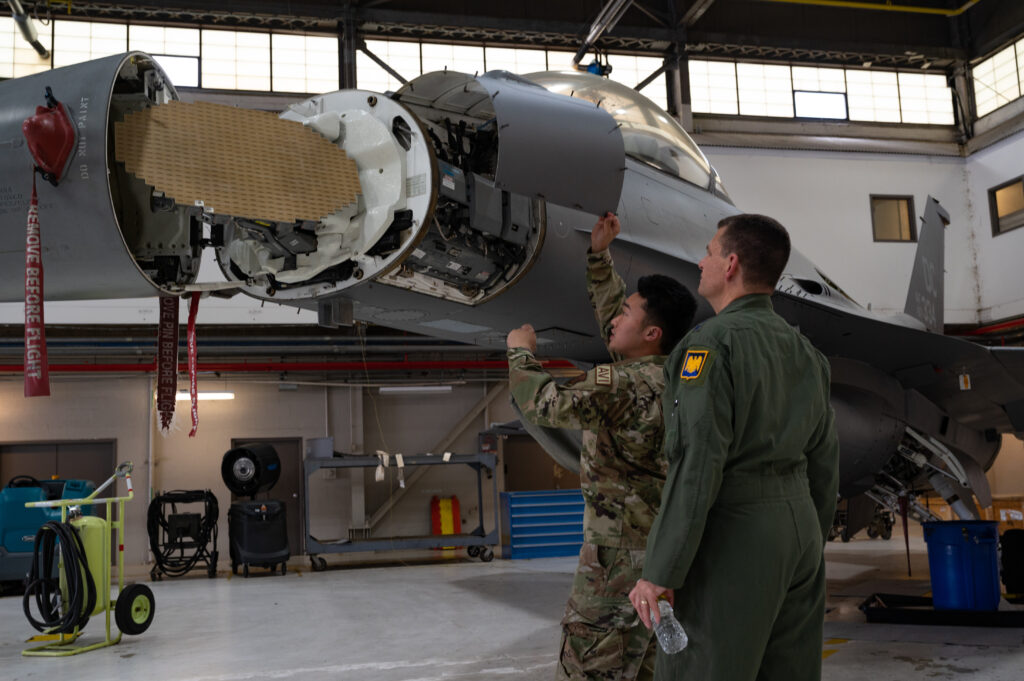
An active electronically scanned array (AESA) radar uses hundreds or even thousands of small transmit/receive modules (TRMs) to electronically steer radar beams, enabling rapid target scanning without physically moving the antenna.
This architecture enables AESA systems to track multiple threats simultaneously, switch between missions quickly, and operate more effectively in environments vulnerable to electronic attack.
AESA radars are now widely used on fighter aircraft, naval warships, airborne early warning systems, ground-based air defense networks, and even some space-tracking applications.
How AESA Technology Came to Be
The foundations of AESA can be closely tied to the development of the passive electronically scanned array radar in the 1960s. But the true AESA breakthrough came with the development of compact solid-state TRMs capable of independently generating and receiving radar signals.
Defense companies such as Raytheon, Northrop Grumman, and Lockheed Martin, as well as European and Japanese firms such as Thales Group, Leonardo, and Mitsubishi Electric, played major roles in advancing operational AESA systems.
Key milestones:
- 1980s to 1990s: The technology of Gallium Arsenide Monolithic Microwave Integrated Circuit TRMs led to the development of active-element phased array radars.
- 1988: The first serially produced shipborne AESA radar was the OPS-24 aboard the Japanese Asagiri-class destroyer.
- 1995: Japan’s J/FPS-3 air-surveillance radar is widely regarded as the world’s first operational military ground-based AESA radar.
- 2000: The Mitsubishi F-2 combat fighter entered service with the first operational AESA, Mitsubishi Electric’s J/APG-1.
- 2020s: The first operational US fighter equipped with the AESA radar was the F-15 with Raytheon’s APG-63(V)2.
How AESA Radar Works
To understand what makes AESA a genuine leap, it helps to understand what it replaced.
Older mechanically scanned radars worked exactly as they sound: a physical antenna rotated to sweep the sky, painting a picture of what was out there one arc at a time. That rotation took time.
In the gap between sweeps, a fast-moving target could move, a missile could close distance, or a threat could disappear entirely. The radar was only looking at one place at a time.
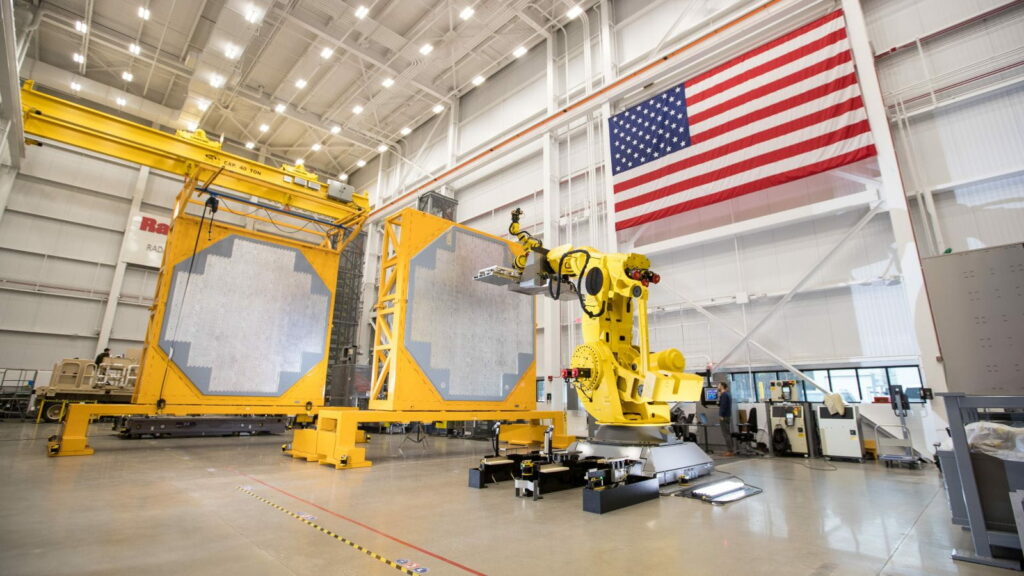
AESA eliminates that constraint at the hardware level. Instead of one antenna moving through space, an AESA array consists of hundreds or thousands of individual transmit/receive modules, each capable of sending and receiving radar signals independently.
By adjusting the timing and phase of signals across those modules, the system can steer a beam in any direction almost instantaneously — no moving parts, no mechanical delay, no blind spots between sweeps.
Electronic beam steering means an AESA radar can be tracking an incoming missile, mapping terrain below, and scanning for new contacts simultaneously; tasks that would have required separate dedicated systems on an older platform. A fighter pilot gets a single integrated picture rather than switching between modes and losing awareness in the transition.
Low probability of intercept works because AESA systems can hop between frequencies and vary their emission patterns in ways that make the radar signal extremely difficult for an adversary to detect or lock onto for jamming. A conventional radar broadcasts on a predictable frequency. It is, in effect, announcing itself. An AESA system is far harder to hear.
Survivability is also fundamentally different.
In a mechanically scanned radar, damage to the antenna or drive mechanism can disable the entire system. In an AESA array, individual modules can fail or take damage without taking the radar offline.
Strengths
- Faster target processing: AESA systems can track multiple targets simultaneously while rapidly updating target positions in real time.
- Improved survivability: The distributed transmit/receive architecture means damage to individual modules does not necessarily disable the entire radar.
- Enhanced EW resistance: Modern AESA systems are significantly more resistant to jamming, spoofing, and electronic attack.
Limitations
- Thermal management challenges: Large numbers of active modules generate substantial heat, requiring advanced cooling systems.
- Integration complexity: Modern AESA radars require sophisticated software, computing power, and sensor fusion infrastructure.
Variants of AESA Radar
Although AESA is often discussed as a single technology, several configurations exist depending on mission requirements.
Airborne AESA Systems
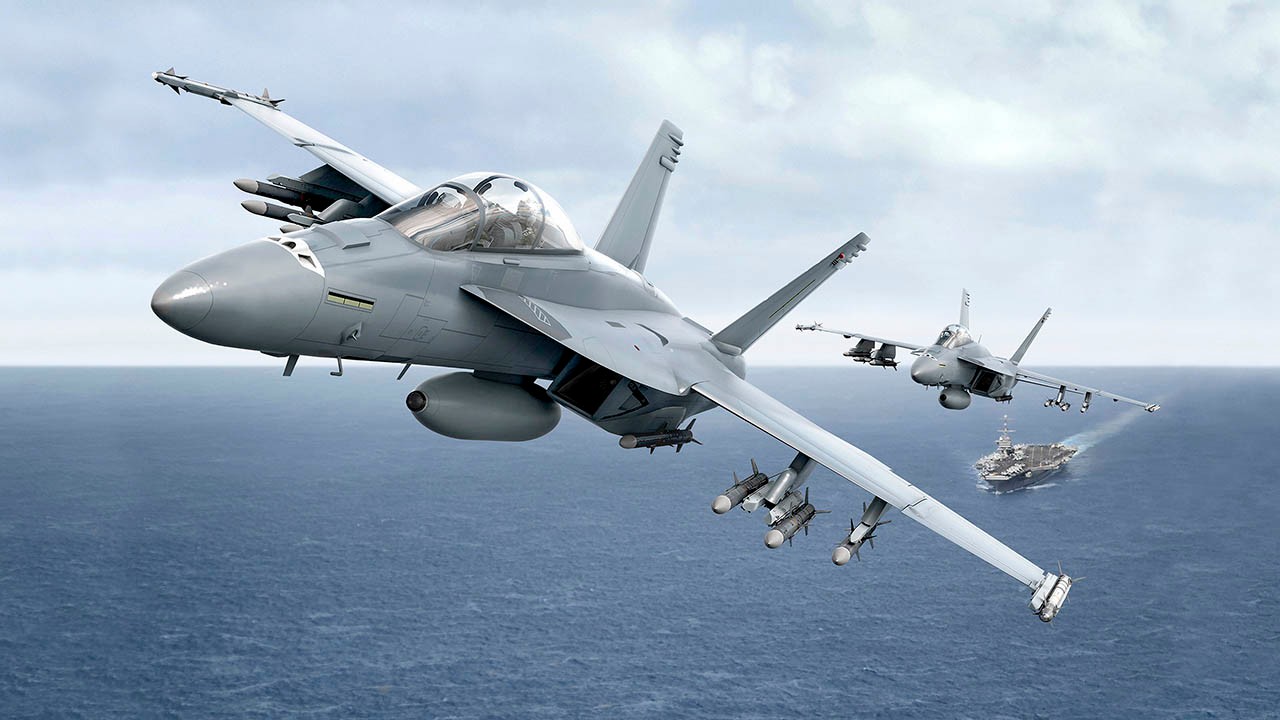
Fighter aircraft AESA radars prioritize compact size, rapid target acquisition, and multi-role operation. Examples are the AN/APG-81 aboard the F-35 Lightning II, the AN/APG-77 on the F-22 Raptor, and the Captor-E radar used on the Eurofighter Typhoon.
Naval AESA Systems
Warship-mounted AESA radars focus on wide-area surveillance, missile defense, and simultaneous air and surface tracking. Systems such as the SPY-series radars aboard US Navy destroyers form the backbone of modern naval air defense networks.
Ground-Based AESA Systems
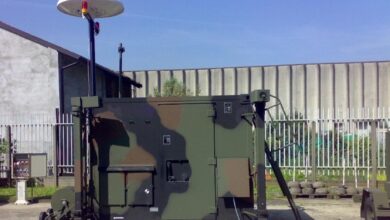
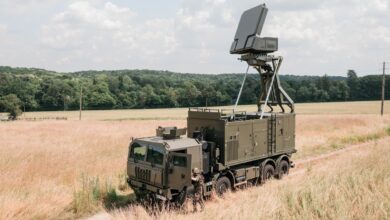
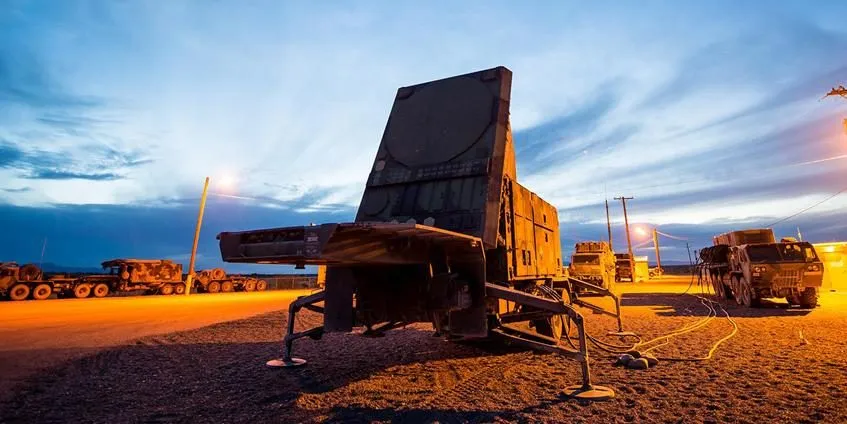
Land-based AESA systems support air defense, counter-battery missions, and long-range surveillance. These systems are often integrated into national missile defense architectures, such as the Patriot AN/MPQ-65, the SAMP/T Arabel Radar, and the TRML-4D.
Global Use of AESA Technology
AESA radar began as a decisive American advantage. The technology matured first in US systems, and for years, the gap between American airborne AESA and what adversaries could field was significant enough to be a genuine combat differentiator.
That gap has narrowed. China’s development of AESA systems for platforms including the J-20 and J-16 represents a serious indigenous capability, not a derivative of Western technology.
Russia has pursued AESA integration on its latest fighters as well, though sanctions and semiconductor access constraints following 2022 have complicated that trajectory.
Meanwhile, US allies across Europe, Israel, Japan, and South Korea have all fielded or are developing their own competitive systems, meaning AESA is no longer a technology the West holds exclusively — it’s a baseline expectation for any serious air combat platform.
The result is that the electronic warfare environment has become significantly more contested.
When both sides have AESA, the advantage shifts to whoever has better software, better processing, and better integration with the broader sensor network, which is exactly where the next round of competition is playing out.
Future Outlook
The future of AESA radar is closely tied to advances in semiconductor technology, artificial intelligence, and network-centric warfare.
New gallium nitride-based arrays promise greater power efficiency and detection range, while AI-assisted processing may further improve target recognition and threat prioritization.
As militaries pursue multi-domain operations and increasingly autonomous systems, AESA radars are expected to become even more interconnected, functioning not only as sensors but also as communication nodes and EW tools within larger combat networks.
Far from replacing traditional radar alone, AESA technology has fundamentally reshaped how modern forces detect, track, and engage threats across the battlefield.