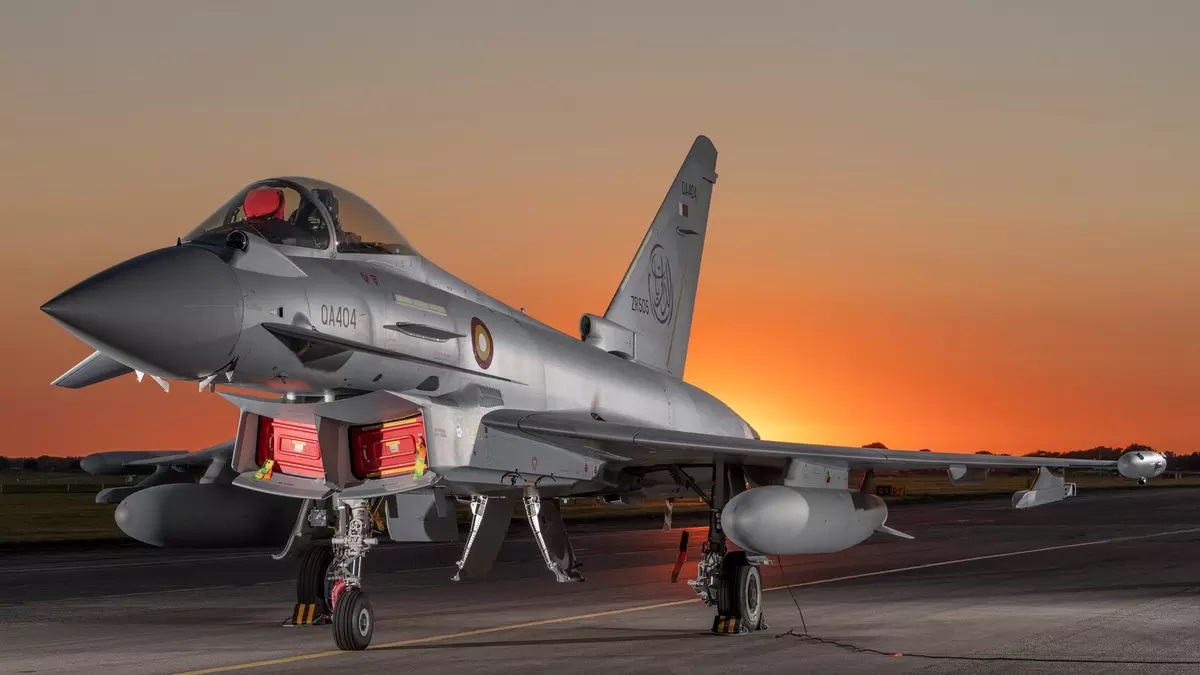
Modern air combat demands flexibility — fighters must switch roles in seconds, from air superiority to strike missions to reconnaissance support. Few aircraft embody that versatility better than the Eurofighter Typhoon.
Developed as a multinational response to evolving threats, it remains one of Europe’s most capable frontline combat aircraft.
Here’s how the Typhoon came to be, what it does, and why it continues to anchor European airpower today.
At a Glance
| Category: | Details: |
| Type | Twin-engine multirole fighter aircraft |
| Role | Air superiority, interception, strike, suppression of enemy air defenses, reconnaissance |
| Manufacturer Consortium | Eurofighter Jagdflugzeug GmbH |
| Program Partners | UK, Germany, Italy, Spain |
| Primary Operators | UK, Germany, Italy, Spain, Austria, Saudi Arabia, Qatar, Kuwait, Oman |
| Crew | 1 (single-seat) / 2 (twin-seat trainer variant) |
| Engine | 2 × Eurojet EJ200 afterburning turbofan engines |
| Maximum Speed | Mach 2+ (2,470+ kilometers/1,535+ miles per hour) |
| Combat Radius | Approximately 1,390 kilometers (864 miles) |
| Ferry Range | 3,700+ kilometers (2,300 miles) with external fuel tanks |
| Service Ceiling | Approximately 55,000 feet (16,764 meters) |
| Length | 15.96 meters (52.3 feet) |
| Wingspan | 10.95 meters (35.9 feet) |
| Maximum Takeoff Weight | Around 23,500 kilograms (51,809 pounds) |
| Radar | Captor-M mechanically scanned radar / Captor-E AESA radar (newer variants) |
| Avionics | Digital glass cockpit, sensor fusion, helmet-mounted display |
| Internal Gun | 27 mm Mauser BK-27 cannon |
| Air-to-Air Weapons | AIM-120 AMRAAM, Meteor, IRIS-T, ASRAAM |
| Air-to-Ground Weapons | Storm Shadow, Brimstone, Paveway bombs, Taurus KEPD 350 |
| Data Links | NATO-compatible tactical data-sharing systems |
What Is the Eurofighter Typhoon?
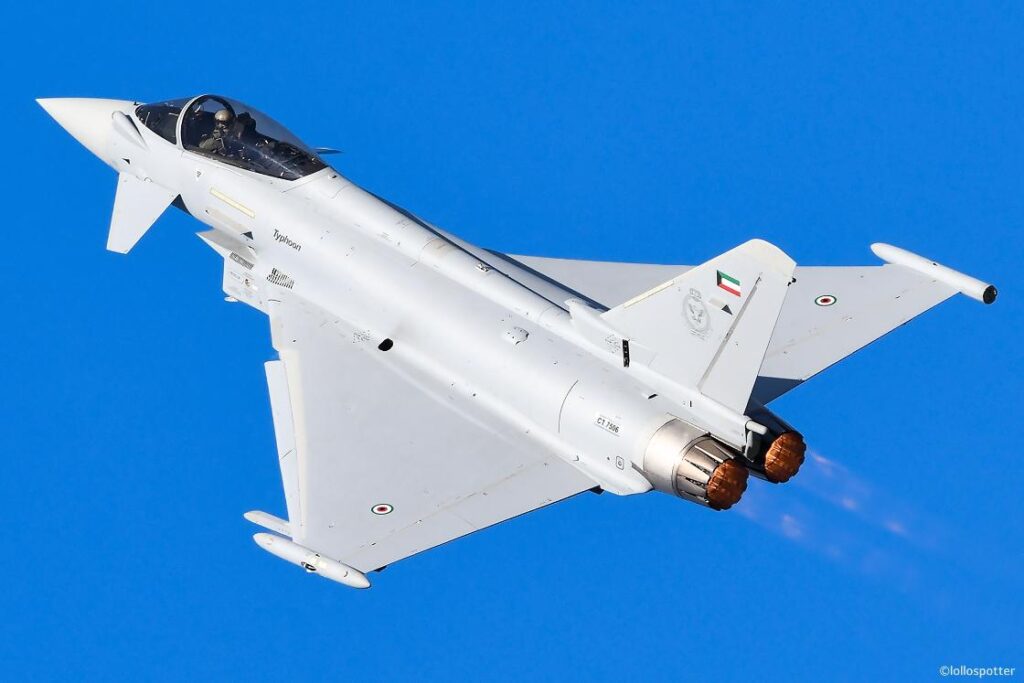
The Eurofighter Typhoon is a twin-engine, multirole fighter aircraft designed for both air superiority and precision strike missions.
It is operated by a consortium of European nations through Eurofighter Jagdflugzeug GmbH and serves in the air forces of numerous countries and several export customers.
The Eurofighter is optimized to dominate contested airspace while retaining the flexibility to deliver ground attack capabilities when required.
The jet sits alongside a generation of capable Western fighters. Here’s how it stacks up against its closest peers.
| Category | Eurofighter Typhoon | F-35 Lightning II | Dassault Rafale | JAS 39 Gripen |
| Country of Origin | UK, Germany, Italy, Spain | United States | France | Sweden |
| Generation | 4.5-generation | Fifth-generation | 4.5-generation | 4.5-generation |
| Primary Strength | Air superiority and high-speed interception | Stealth and sensor fusion | Omnirole flexibility | Cost-effective multirole operations |
| Engines | 2 × Eurojet EJ200 afterburning turbofan engines | 1 × Pratt & Whitney F135 afterburning turbofan | 2 × Safran M88 afterburning turbofans | 1 × Volvo RM12 (Gripen C/D) or 1 × General Electric F414G (Gripen E/F) |
| Max. Speed | Mach 2+ | Mach 1.6 | Mach 1.8 | Mach 2 |
| Stealth Features | Reduced radar signature | Advanced stealth design | Limited radar reduction | Limited radar reduction |
| Radar | Captor-E AESA | AN/APG-81 AESA | RBE2 AESA | Raven ES-05 AESA |
| Combat Radius | 1,390 kilometers (863.7 miles) | 1,100+ kilometers (683.5 miles) | 1,850 kilometers (1,149.5 miles) | 800+ kilometers (497 miles) |
| Supercruise Capability | Yes | Limited | Yes | Yes |
| Mission Roles | Air dominance, strike, interception | Stealth strike, ISR, multirole combat | Air-to-air, strike, naval operations | Air defense, interception, multirole |
| Carrier Variant | No | Yes (F-35B/C variants) | Yes (Rafale M) | No |
| Key Advantage | Exceptional agility and BVR combat | Low observability and networked warfare | Multi-mission versatility | Lower operating cost and maintenance footprint |
| Key Limitation | Not a true stealth aircraft | Expensive sustainment | Smaller production scale | Smaller payload and range compared to larger fighters |
Origins and Development
The Eurofighter program began in the 1980s as European air forces sought a replacement for aging Cold War-era fighters. The goal was ambitious: develop a single platform capable of matching emerging Soviet aircraft while remaining adaptable for future threats.
Key Milestones
- 1983 to 1986: European Future Fighter Aircraft studies initiated
- 1986: Formal Eurofighter consortium established
- 1994: First prototype flight
- 2003: Initial operational service begins
- 2010s to present: Continuous upgrades across radar, weapons, and avionics
The aircraft was developed collaboratively by the UK, Germany, Italy, and Spain, making it one of the most complex multinational defense programs ever undertaken.
Design Philosophy
The Eurofighter Typhoon was designed around a core principle of air dominance first, with multirole flexibility as a secondary strength.
Its aerodynamic design emphasizes high agility in close-range combat, sustained supersonic flight without relying on afterburners in certain configurations, and stable performance across extreme flight conditions.
These characteristics are paired with rapid response interception capability, making the aircraft particularly effective in quick-reaction alert missions where speed, climb performance, and immediate readiness are critical for intercepting airborne threats.
Inside the Typhoon
Key Capabilities and Systems
The Typhoon combines advanced aerodynamics with highly integrated avionics:
- Captor-E AESA radar (upgraded variants) for long-range target detection
- Sensor fusion systems for real-time battlefield awareness
- Digital fly-by-wire controls for extreme maneuverability
- Helmet-mounted targeting systems for off-boresight engagements
- Multirole weapons compatibility, including air-to-air and precision-guided munitions
It is designed to operate as part of a networked battlespace, sharing data with other aircraft, ground units, and airborne assets.
Strengths
- Exceptional air-to-air performance and agility
- Strong sensor and radar integration in upgraded variants
- Highly adaptable multirole mission profile
- Continuous upgrade pathway across partner nations
- Proven operational deployment across multiple theaters
Limitations
- Higher operating costs compared to lighter multirole fighters
- Early variants relied on less advanced radar systems
- Less optimized for stealth compared to fifth-generation platforms
- Complex multinational logistics and upgrade coordination
Operational Use and Global Deployment
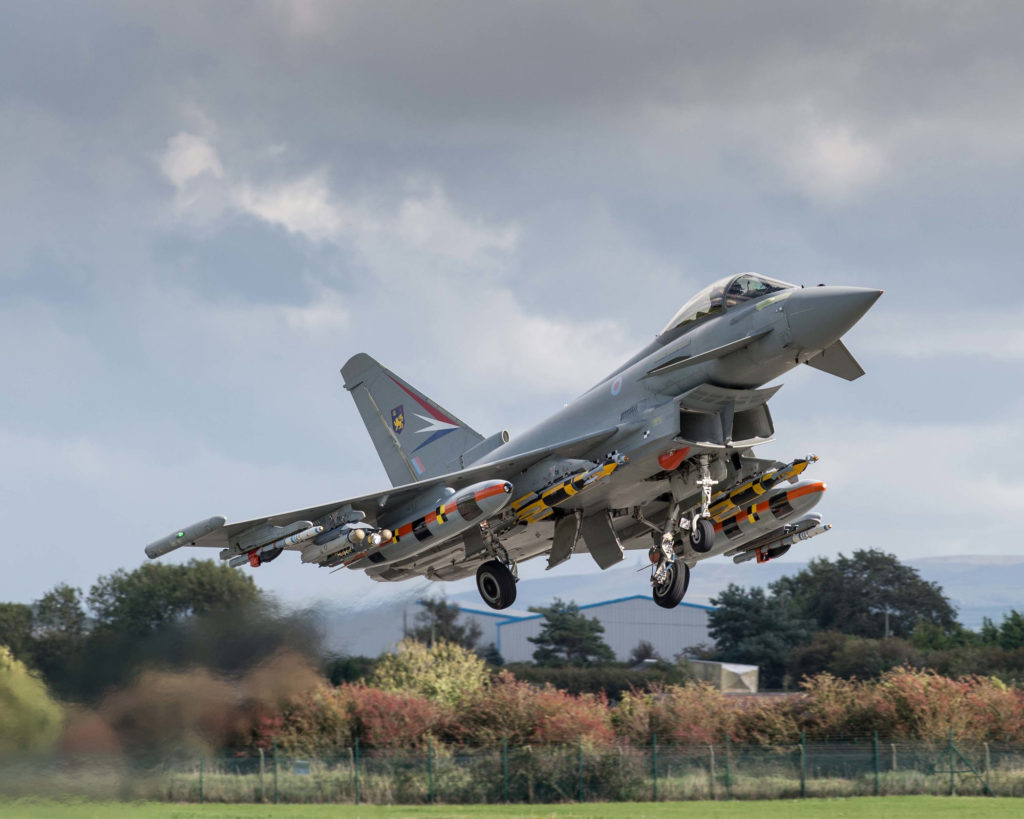
The Typhoon is actively used for air policing, rapid interception, and NATO multinational missions.
Operators such as the Royal Air Force regularly deploy it for Quick Reaction Alert duties, while German and Italian forces use it extensively in NATO Baltic Air Policing missions.
It has also been purchased or deployed operationally in Turkey and the Middle East, demonstrating its flexibility in both air-to-air and precision-strike roles.
Saudi Arabia and Qatar rank among the largest export operators of the Eurofighter Typhoon, using the platform to strengthen regional air defense, deterrence, and precision strike capability.
Saudi Arabia has deployed the Typhoon extensively for air policing, territorial defense, and combat operations, including missions linked to the Yemen conflict, where the aircraft has conducted strike and support sorties.
Qatar, meanwhile, acquired the Typhoon as part of a broader military modernization effort aimed at expanding interoperability with Western allies and improving rapid response air combat capability in the Gulf region.
Future Outlook
While the UK, Italy, and Japan are jointly developing the sixth-generation Global Combat Air Programme (GCAP), that platform isn’t expected to enter service until the mid-2030s at the earliest. Until then, the Typhoon carries the load.
Current upgrades are substantial: Captor-E AESA radar rollout across partner fleets, Meteor long-range air-to-air missile integration, the potential addition of the Advanced Precision Kill Weapon System, and deeper NATO network connectivity are all either underway or operational.
The bigger structural question is Germany and Spain, both of which are also procuring the F-35.
That two-platform dynamic will likely see the Typhoon repositioned toward air policing, interception, and suppression of enemy air defenses rather than retired early. For Middle East operators without F-35 access, the upgrade runway is longer still.
The Typhoon’s future isn’t in question. The shape of it is — whether that means a narrower NATO role focused on interception and suppression of enemy air defenses, a shrinking production line as F-35 orders displace new Typhoon contracts, or a longer operational life sustained by Middle East operators with no fifth-generation alternative on the horizon.