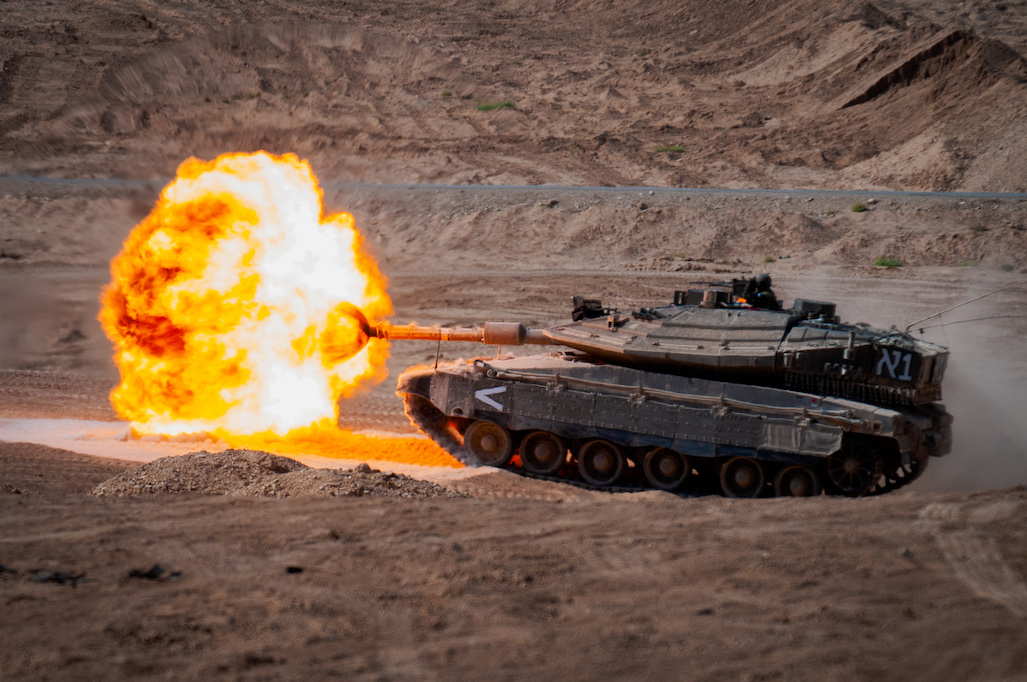
Built around the realities of ambushes, confined terrain, and close-range combat, the Israeli Merkava tank treats crew survivability as a central requirement rather than a secondary consideration.
The tank’s architecture reflects operational priorities, where protecting personnel has long carried equal weight with battlefield effectiveness.
Discover how the Merkava became one of the most uniquely designed tanks in modern armored warfare.
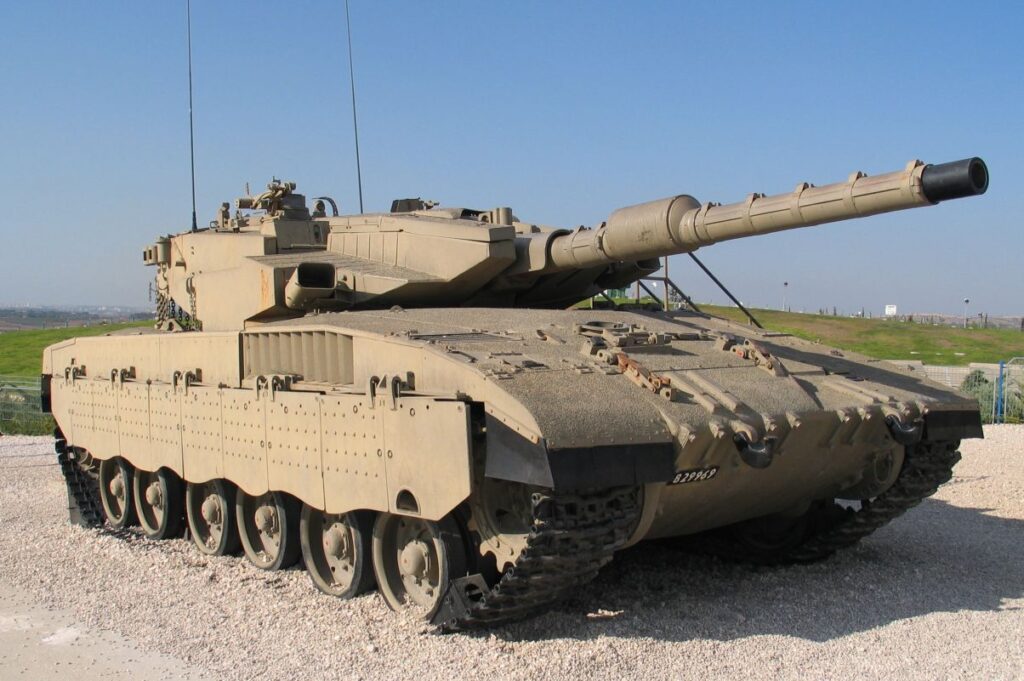
What Is the Merkava Tank?
The Merkava tank is Israel’s primary main battle tank (MBT) and the backbone of the Israel Defense Forces’ armored corps.
Developed for frontline operations across varied combat environments, it has remained a central component of Israeli ground warfare doctrine since its introduction.
The Merkava is often viewed as more than just another MBT, but as a product of the kind of warfare Israel expected to fight — one marked by dense urban terrain, sudden ambushes, and close-range engagements.
As armored warfare continues to evolve, the platform remains a recurring topic in debates over survivability, battlefield adaptation, and the future role of tanks in modern combat.
At a Glance
| Category: | Details: |
| Type | Main battle tank |
| Role | Armored warfare, urban combat, defensive operations |
| Country of Origin | Israel |
| Developer | Israeli Ministry of Defense (primary leader of development) |
| Crew | 4 (commander, gunner, loader, driver) |
| Armament | Main: 120mm smoothbore gun for Mk 3/4 variants Secondary: Coaxial machine guns, roof-mounted machine guns |
| Weight | Around 65 to 70 tonnes (143,300 to 154,324 pounds) |
| Speed | Top Road: 60 to 65 kilometers/37 to 40 miles per hour (variant dependent) Off-Road: 40 to 50 kilometers/25 to 31 miles per hour (typical operational range) |
| Engine | V12 diesel engine (varies by variant; ~1,200-1,500 hp class) |
| Protection Systems | Modular composite armor, active protection systems (Merkava Mk 4 variants) |
How It Came to Be
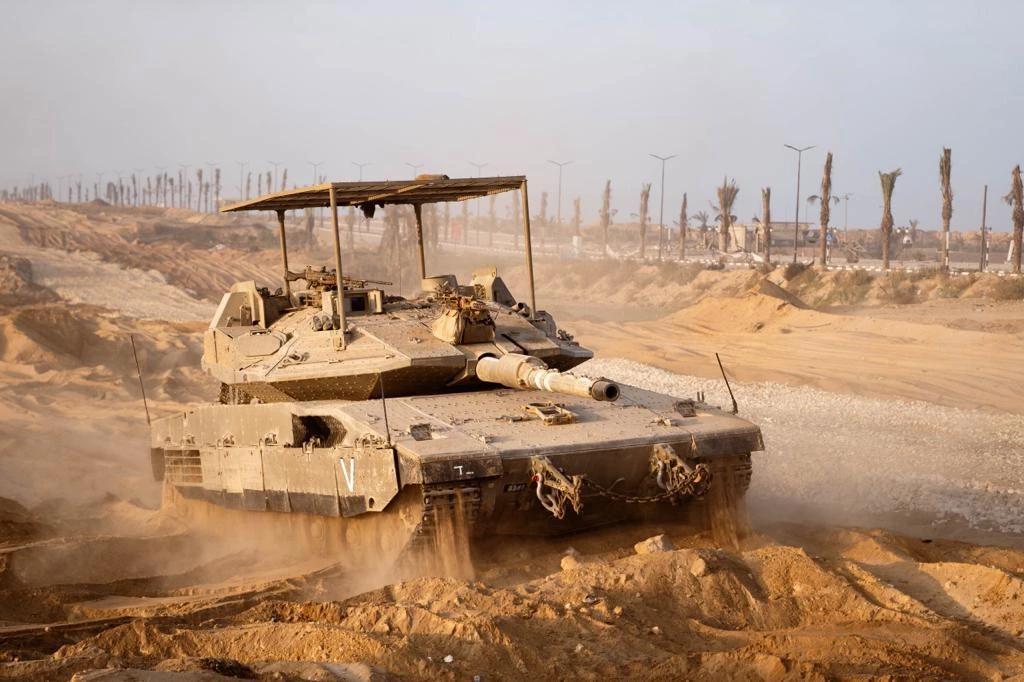
The Merkava program emerged in the 1970s, following Israel’s reassessment of its armored warfare requirements following regional conflicts and concerns about reliance on foreign suppliers.
Development was led by Major General Israel Tal, a veteran tank commander whose experience in Israel’s armored engagements directly shaped the program’s founding premise: that keeping the crew alive was as important as killing the enemy.
His influence is visible in virtually every unconventional design decision the Merkava reflects.
Key milestones in the Merkava program include:
- Early 1970s: Initial development begins following Israel’s postwar armored warfare assessments.
- 1979: The Merkava Mk 1 officially enters Israeli military service.
- 1980s to 1990s: The Mk 2 and Mk 3 introduced progressive improvements in protection, mobility, and fire control systems.
- 2004: The Merkava Mk 4 enters service as the most advanced variant of the platform.
- 2010s onward: Active protection systems are integrated to address evolving anti-tank threats and modern combat conditions.
Variants
The Merkava has evolved through several generations:
- Merkava Mk 1 and 2: Early models established the platform’s core design
- Merkava Mk 3: Introduced a more powerful 120 mm main gun, upgraded fire control systems, and improved mobility
- Merkava Mk 4: Featured a redesigned chassis, modular armor upgrades, vastly improved propulsion, and integration of Trophy, an active protection system that detects, tracks, and intercepts incoming anti-tank rockets and missiles before they reach the vehicle
- Merkava Mk 4 Barak: Latest modernization standard focused on digital battlefield systems, enhanced sensors, AI-assisted functions, and improved crew situational awareness
How It Works
Merkava’s Key Features
Protection-Centered Design
The Merkava’s layout places the engine at the front, acting as an additional protective barrier for the crew compartment. This unconventional design improves survivability against frontal attacks, especially in ambush-heavy environments.
Firepower and Targeting Systems
It is equipped with a 120mm smoothbore gun capable of firing a range of advanced munitions. Modern variants integrate advanced fire control systems, allowing accurate targeting in both day and night conditions, even while moving.
Mobility and Battlefield Adaptation
Despite its heavy armor, the Merkava is designed for maneuverability in rough and urban terrain. Its suspension and powertrain support operations in environments where rapid repositioning and close engagement are common.
Rear Hull Access and Infantry/Casualty Evacuation System
Infantry can enter and exit the tank from the rear and safely evacuate casualties. This door enables the vehicle to temporarily serve as an armored extraction platform, improving survivability and medical recovery during troop movement.
Strengths
- Strong emphasis on crew survivability
- Front-engine design adds protection layer
- Advanced battlefield awareness systems (new variants)
- Optimized for urban and asymmetric environments
Limitations
- Heavier and less suited for long-range deployment by air
- High logistical and maintenance requirements
- Less common in export markets compared to other MBTs
Global Use and Operational Role
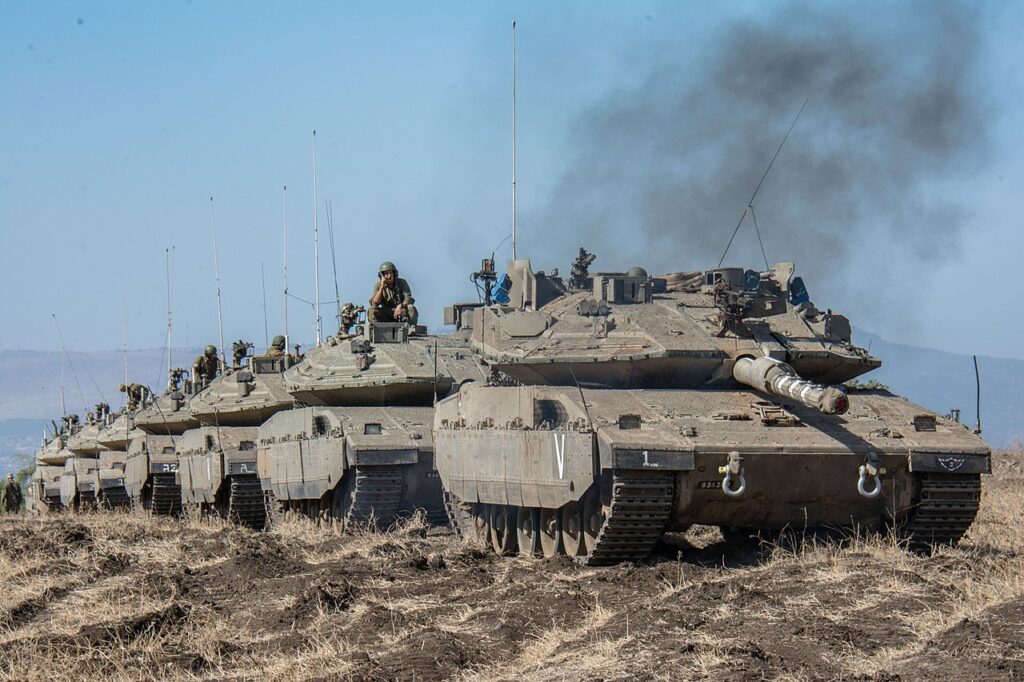
The Merkava is primarily operated by the Israel Defense Forces and is rarely exported, making it a uniquely national platform.
Notable combat deployments include:
- 1982 Lebanon War: One of the Merkava’s earliest major combat deployments, where it was used extensively in armored operations in southern Lebanon.
- Second Intifada (2000s): Frequently deployed in urban combat and counterinsurgency operations within dense and high-risk environments.
- Gaza conflicts (2008 onward): Merkava tanks were used to support ground incursions, provide direct fire support to infantry units, breach fortified positions, and counter Hamas anti-tank teams operating within dense urban areas.
- Post-October 7, 2023 operations: Merkava M4 tanks were rapidly mobilized during Israel’s ground response in Gaza. The tanks spearheaded armored advances and provided sustained direct-fire support, but have been targets of heavy munitions.
Future Outlook
The Merkava continues to evolve toward more networked and digitally integrated warfare systems, particularly with the Mk 4 Barak variant.
Future development is likely to focus on integrating unmanned systems support, improved active protection, and greater situational awareness rather than simply increasing armor or firepower.