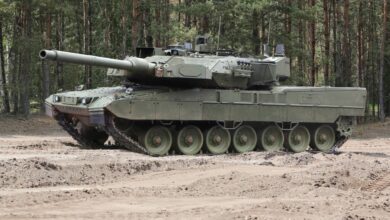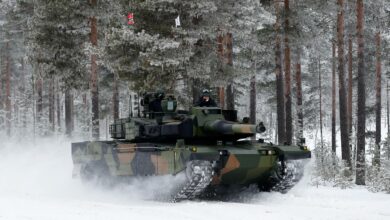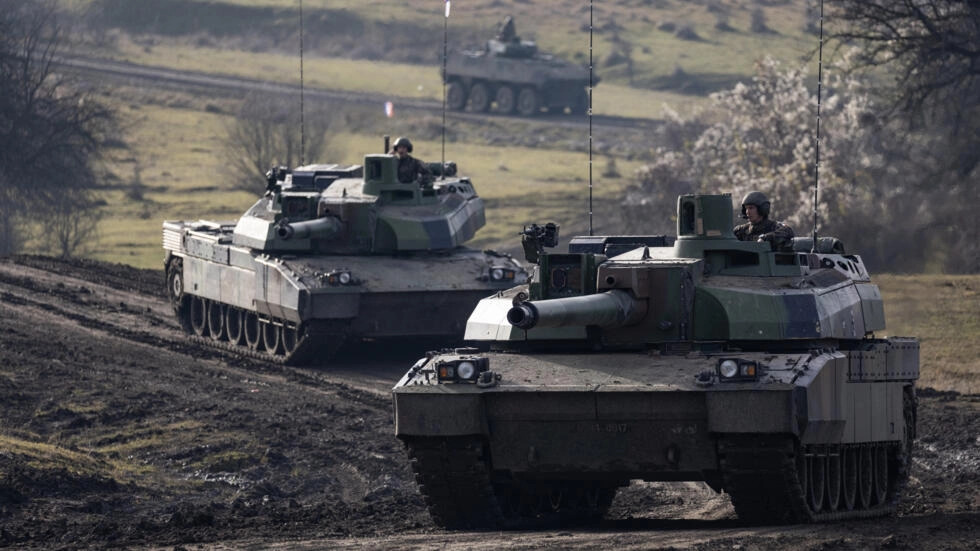
The Leclerc was built to be one of the most advanced main battle tanks of its generation, combining digital systems, mobility, and firepower in a package that set it apart from many of its contemporaries.
Yet despite its technological sophistication, the tank has spent much of its service life facing questions about its high cost, limited fleet size, and relatively modest operational record.
Today, the Leclerc occupies a unique place in the armored warfare landscape: respected for its capabilities but often overshadowed by more widely deployed rivals.
Explore our guide to learn how it was developed, what makes it different, how it has performed in service, and what challenges could shape its future.
At a Glance
| Category: | Details: |
| Type | Third-generation main battle tank |
| Role | Frontline armored warfare |
| Manufacturer | KNDS France |
| Length | 9.87 meters (32.4 feet) with gun forward |
| Height | 2.53 meters (8.3 feet) |
| Width | 3.71 meters (12.2 feet) |
| Weight | 57.4 tons |
| Armament | Main: 120mm smoothbore gun Secondary: 12.7mm coaxial MG and 7.62mm MG |
| Engine | V8X-1500 Hyperbar diesel engine |
| Maximum Speed | 72 kilometers (45 miles) per hour on the road |
| Range | 550 kilometers (342 miles) with auxiliary tanks |
| Protection | Modular composite armor, active protection systems |
| Crew | 3 (commander, gunner, driver) |
What Is the Leclerc Tank?
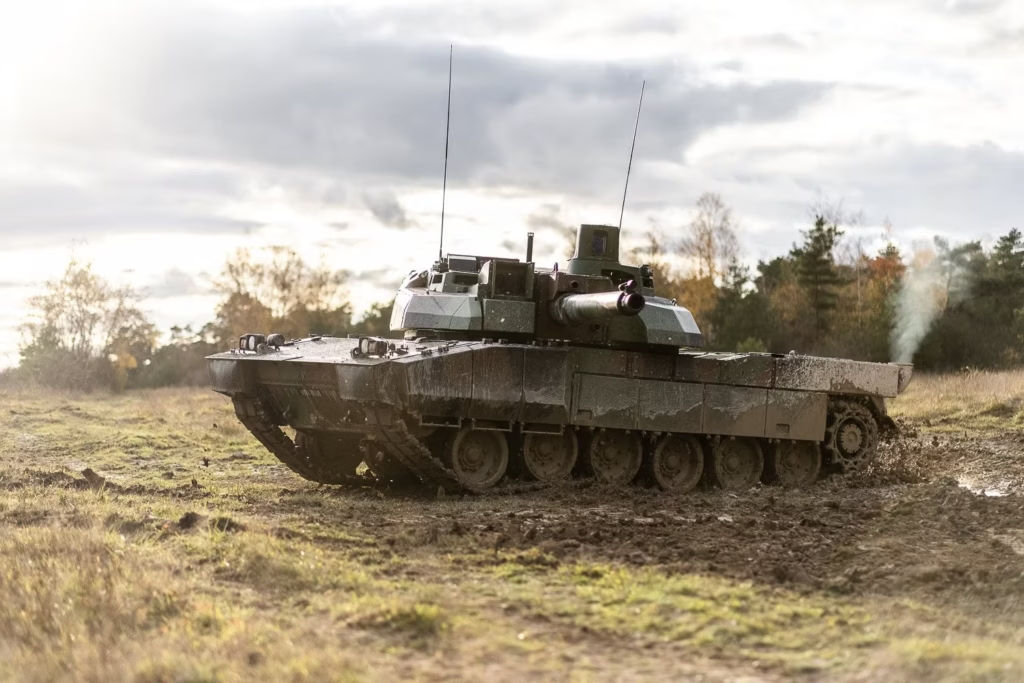
The Leclerc is a French third-generation main battle tank (MBT) developed during the final years of the Cold War to combine firepower, protection, and mobility in a highly digitized platform.
At a time when many Western armies still relied on larger crews and more conventional architectures, France pursued an ambitious design centered on automation, battlefield networking, and rapid maneuver.
The result was one of the most technologically advanced tanks of its era, though its sophistication also contributed to higher costs and a smaller production run than some of its contemporaries. The Leclerc places particular emphasis on:
- High battlefield mobility
- Rapid target engagement
- Advanced fire-control and digital systems
- Crew efficiency through automation, including its autoloader system
The MBT remains a respected but often underutilized platform, with its relatively small fleet size, limited export success, and high costs continuing to shape perceptions of its long-term impact on modern armored warfare.
Origins and Development
The Leclerc program began during the late Cold War as France pursued a next-generation successor to the AMX-30 while maintaining an independent domestic tank industry.
Development was led by GIAT Industries (later renamed Nexter Systems), which is now part of KNDS France.
Key milestones in the program:
- Late 1970s to early 1980s: France begins studies for a new main battle tank under the Engin Principal de Combat program
- 1986: Full-scale development of the Leclerc officially moves forward under GIAT Industries
- 1990: Initial production vehicles and testing phases are completed ahead of operational introduction
- 1992: The Leclerc officially enters service with the French Army
- 1990s to 2000s: Export variants are produced for the UAE, becoming the tank’s largest foreign operator outside France
The Leclerc Tank Family
Although the Leclerc family is smaller than those of many competing main battle tanks, several variants reflect France’s efforts to adapt the platform to evolving operational requirements:
Leclerc Series 1 and 2
Early production models that introduced incremental improvements to electronics, protection, and onboard systems as the platform matured.
These variants formed the backbone of France’s armored forces during the tank’s initial years of service and helped refine technologies that would be carried into later upgrades.
Leclerc AZUR
Developed in response to lessons from urban warfare, the AZUR package added enhanced protection against close-range threats such as rocket-propelled grenades and attacks from densely populated environments.
The variant reflected a broader shift in military thinking, adapting the Leclerc from a Cold War-era battlefield design to the urban conflicts that increasingly dominated 21st-century operations.
Leclerc XLR
The most significant modernization of the platform to date. Developed under France’s Scorpion program, the XLR introduces improved protection and updated electronics to extend the Leclerc’s service life as the Main Ground Combat System program remains distant.
However, the program has faced scrutiny over delays and delivery pace, while some newly introduced survivability features, including anti-drone protection measures inspired by lessons from Ukraine, have drawn criticism from observers who question their effectiveness and appearance.
These debates underscore the broader challenge of adapting legacy armored platforms to rapidly evolving battlefield threats.
Leclerc EAU
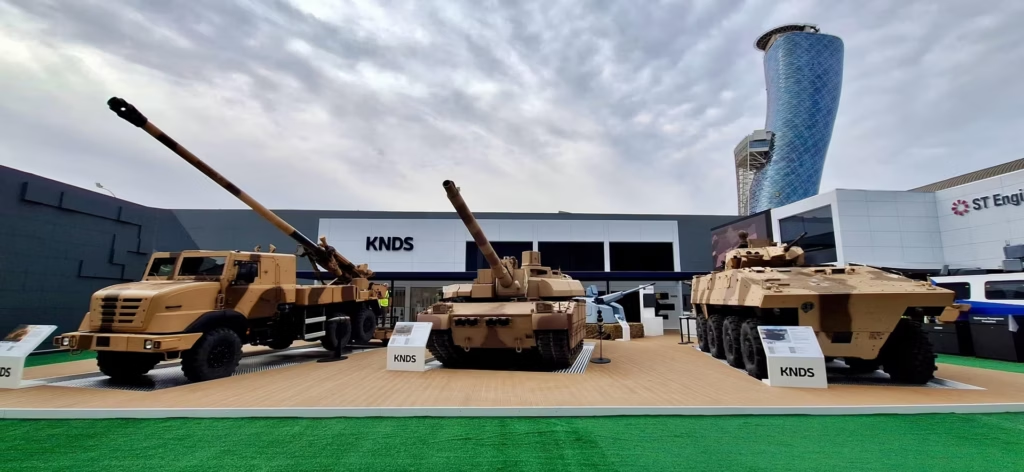
A customized export version designed for operations in hot and arid environments. The variant incorporates adaptations for desert conditions and represents Leclerc’s only major export success.
Its operational use by the United Arab Emirates, including deployments linked to the conflict in Yemen, has provided the tank with some of its most significant real-world combat experience.
How the Leclerc Tank Works
The Tank’s Key Features
Firepower and Targeting
The Leclerc is equipped with a 120mm smoothbore gun capable of firing advanced kinetic and programmable rounds. Its autoloader allows a reduced crew of three, increasing internal efficiency and reducing turret size.
The fire control system integrates thermal imaging, laser rangefinding, and digital targeting, enabling high first-round hit probability even while on the move.
Mobility and Engine Performance
One of the Leclerc’s defining characteristics is its speed. Powered by a hyperbar diesel engine, it is among the fastest main battle tanks in the world, reaching 72 kilometers (45 miles) per hour.
Its suspension system allows it to maintain stability at high speeds across uneven terrain, supporting rapid maneuver warfare doctrines.
Protection and Survivability
The tank uses modular composite armor combined with reactive protection packages. Its design emphasizes crew survivability through ammunition compartment separation and automated loading systems that reduce internal exposure risks.
Strengths
- Exceptional first-shot effectiveness: The combination of an advanced fire-control system, thermal imaging, and digital targeting enables the tank to detect, engage, and quickly destroy targets even while moving, improving reaction times in critical situations.
- Adaptability through modular upgrades: Modular armor and upgrade packages have enabled the platform to evolve over time, from urban warfare adaptations under the AZUR program to the ongoing XLR modernization effort.
- Advanced battlefield integration: The Leclerc was among the first Western tanks designed with a strong emphasis on digital systems and battlefield networking. This focus on information sharing and situational awareness remains a key advantage.
Limitations
- High acquisition and sustainment costs: The Leclerc’s advanced electronics, automation, and specialized components have driven higher procurement and support costs than those of many contemporary main battle tanks. The French defense procurement agency’s contract is said to cost around 330 million euros ($376 million) for 200 units.
- Modernization and integration challenges: The program has also faced delays stemming from the complexity of integrating the tank into France’s wider SCORPION network, evolving upgrade requirements, and the challenge of modernizing a relatively small fleet while maintaining operational readiness.
- Unproven in high-intensity modern warfare: Although the Leclerc has seen operational use, particularly with the United Arab Emirates, it lacks the extensive combat record of Western counterparts such as the Abrams or the Leopard 2. As a result, questions remain about how the platform would perform in large-scale, drone-saturated conflicts today.
Global Use and Operational Role
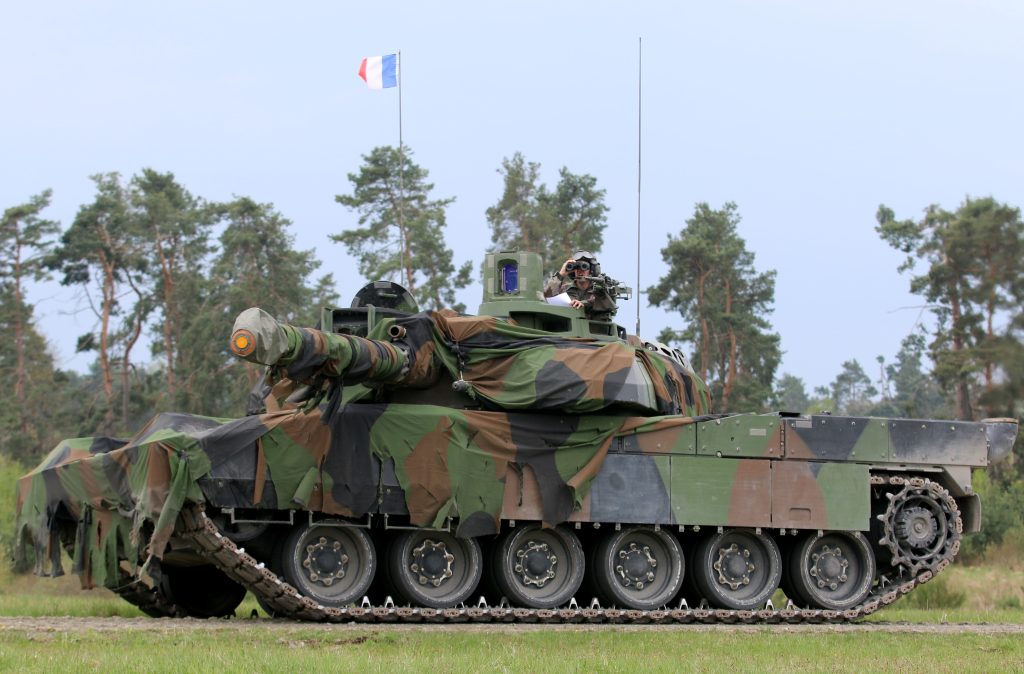
Despite being one of the most technologically advanced main battle tanks of its generation, the Leclerc has had a relatively limited and problematic operational footprint.
France operates a comparatively small fleet, while the UAE remains the tank’s only export customer, providing far less combat service that fuels ongoing debates about its operational relevance and overall influence.
Most French deployments have occurred in expeditionary operations where armored forces provided deterrence, security, and maneuver support.
The UAE’s use of the Leclerc in Yemen, meanwhile, has provided the platform with some of its most significant real-world combat experience, though assessments of its performance remain mixed and continue to fuel debate among defense analysts.
Operational Deployments
- Operation Serval (Mali): During France’s 2013 intervention in Mali, Leclerc tanks supported rapid offensive operations to halt insurgent advances and retake key territory. The deployment demonstrated the platform’s mobility and reliability in harsh environments, but the operation involved limited armored opposition, offering few opportunities to test the tank in high-intensity combat.
- Operation Barkhane (Sahel): As France expanded its counterinsurgency efforts across the Sahel from 2014 to 2022, armored assets played a supporting role in force protection, convoy security, and deterrence. While the Leclerc contributed to France’s regional military presence, the mission highlighted the challenge of employing a high-end main battle tank in conflicts dominated by insurgent groups rather than conventional armored threats.
- UAE deployments: UAE-operated Leclerc variants have been used in regional training exercises and armored readiness operations, particularly in desert warfare conditions.
Future Outlook
With the Franco-German future Main Ground Combat System still years away and facing ongoing industrial and political challenges, the Leclerc is expected to remain the backbone of French armored forces well into the 2030s and potentially beyond. Whether the tank can maintain its relevance, however, remains an open question.
Recent conflicts have highlighted the growing threat posed by drones, loitering munitions, and precision-guided weapons, forcing armies worldwide to rethink the role and survivability of heavy armor.
France’s efforts to adapt the Leclerc to these challenges have drawn both praise and criticism, with modernization delays and debate over some new protective measures underscoring the difficulty of preparing legacy platforms for rapidly evolving battlefields.
Despite its advanced design, the Leclerc remains a relatively niche platform with a small fleet, limited export success, and a combat record that is far less extensive than those of the Abrams or Leopard 2.
As a result, its future legacy may depend less on its technical sophistication and more on whether France can successfully demonstrate the tank’s relevance in an era of networked warfare and emerging threats.