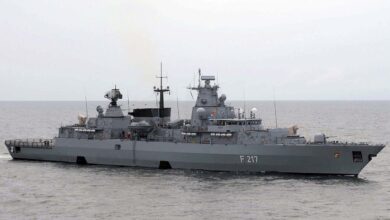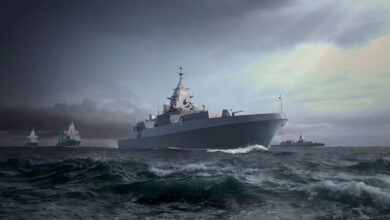
Germany’s parliamentary Budget Committee has approved the procurement of four MEKO A-200 DEU frigates for approximately 6.3 billion euros ($7.2 billion), clearing the way for the formal signing of the contract with TKMS.
Exercising an option to procure four additional frigates would cost approximately 5.3 billion euros ($6.06 billion), according to Hartpunkt.
The procurement follows Berlin’s June decision to cancel the troubled F126 frigate program. Initially conceived as an interim capability to complement the delayed F126 fleet, the MEKO A-200 DEU has since become the program’s replacement.
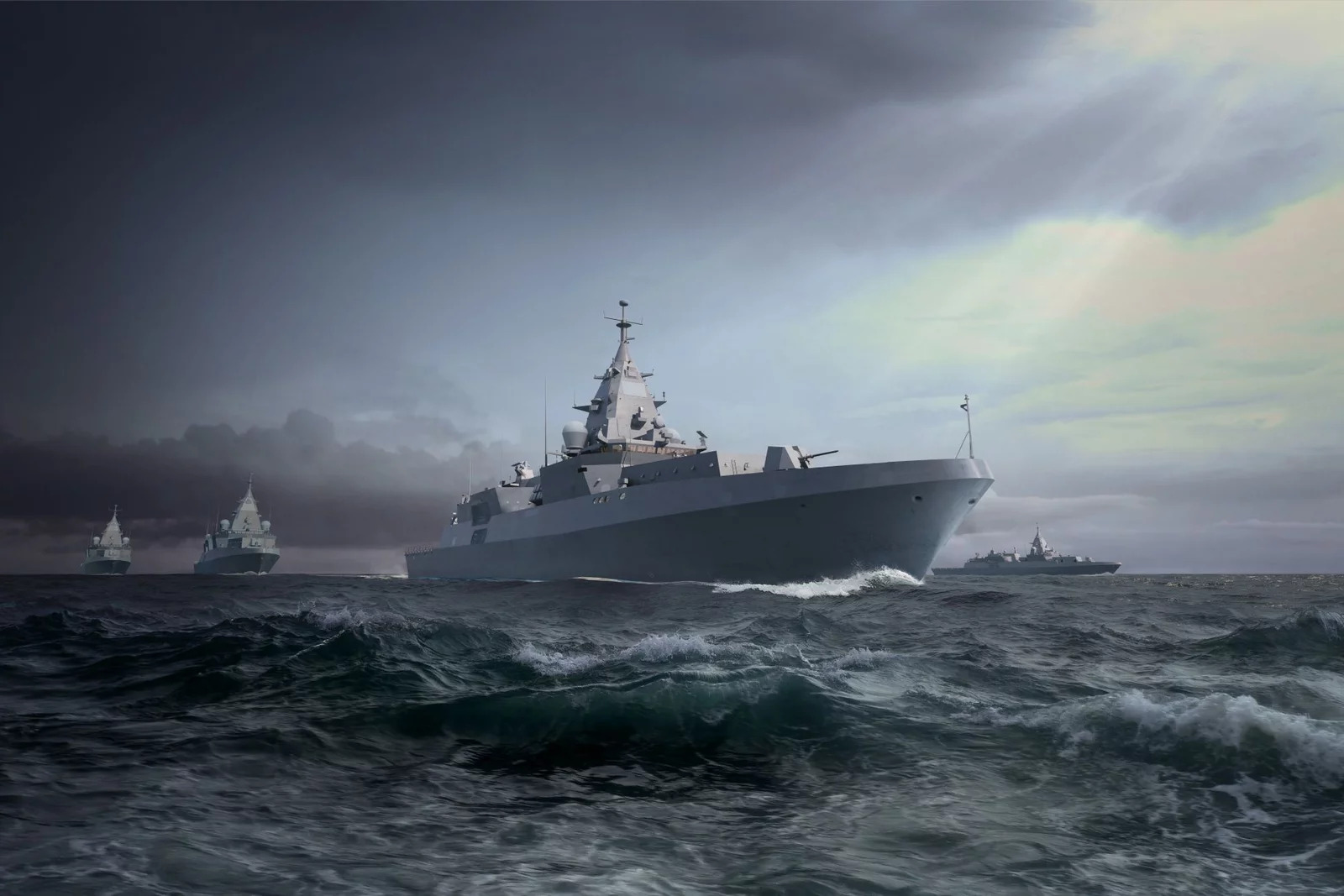
While the roughly 10,000-ton F126 was a new multi-role frigate designed for extended deployments, the approximately 4,000-ton MEKO A-200 DEU is based on a proven design already in service with several navies.
Germany opted for the latter because of its lower cost, faster delivery, and reduced technical risk while retaining the navy’s anti-submarine warfare capability.
The first frigate is scheduled for delivery in December 2029.
“We welcome today’s approval by the German Bundestag’s Budget Committee of the procurement of four MEKO A-200 DEU-class frigates, as well as the option outlined in the resolution to procure additional MEKO A-200 DEU vessels,” TKMS CEO Oliver Burkhard said.
“We are aware of our responsibility to build these ships very quickly due to the security situation, as stipulated in the contracts. We will now address this together with our industry partners from across Germany. Timeline delivery is a key factor for us here.”
MEKO A-200 DEU
Based on a scalable and cost-efficient design, the MEKO A-200 DEU is intended to strengthen the German Navy’s capabilities, particularly in anti-submarine warfare.
The frigate is 121 meters (397 feet) long, with a 16.4-meter (53.8-foot) beam and a 4.4-meter (14.4-foot) draught, displacing approximately 3,950 metric tons at full load.
It is operated by a core crew of 125, with accommodation for up to 49 additional personnel, and can exceed 29 knots (54 kilometers/33 miles per hour) while maintaining a low acoustic signature. At a cruising speed of 16 knots (30 kilometers/18 miles per hour), it has a range of more than 6,500 nautical miles (12,040 kilometers/7,480 miles).
The vessel can accommodate two mission modules, each the size of a standard 20-foot (6.06-meter) shipping container, and operate either two 6-ton helicopters or one 11-ton helicopter alongside two unmanned aerial vehicles.
It is also equipped with two side-mounted launch and recovery systems for deploying 8-meter (26-foot) rigid-hulled inflatable boats, enabling it to perform a wide range of combat, patrol, and support missions.