Long before missiles launch or fighter jets take off, military operations depend on something less glamorous but just as critical: moving people, vehicles, and supplies exactly where they are needed.
The answer became one of the most recognizable transport aircraft ever built — the Boeing C-17 Globemaster III.
Part strategic airlifter, part tactical workhorse, the C-17 has spent decades carrying tanks, humanitarian aid, troops, helicopters, and evacuation teams into some of the world’s most difficult environments.
Here’s a closer look at how the aircraft was developed, what makes it unique, and why it remains one of the most important military transport aircraft in service today.
At a Glance
| Category: | Details: |
| Type | Strategic and tactical military transport aircraft |
| Role | Cargo and troop transport, strategic airlift, tactical airlift, humanitarian relief, medical evacuation |
| Manufacturer | Boeing |
| Total Built | 279 |
| Crew | 3 (pilot, co-pilot, loadmaster) |
| Length | 174 feet (53 meter) |
| Wingspan | 169 feet (51.5 meters) |
| Height | 55.1 feet (16.8 meters) |
| Weight | Empty: Approximately 282,500 pounds (128,140 kilograms) Maximum Takeoff: 585,000 pounds (265,352 kilograms) |
| Engine | 4 × Pratt & Whitney F117-PW-100 turbofans Thrust Per Engine: 40,440 pounds (18,343 kilograms) |
| Maximum Payload | 170,900 pounds (77,519 kilograms) |
| Maximum Speed | Approximately Mach 0.74 (913 kilometers/567 miles per hour) |
| Range | Ferry: More than 6,200 nautical miles (7,134 miles/11,482 kilometers) without payload Combat/Operational: Around 2,400 nautical miles (2,762 miles/4,445 kilometers) with heavy payload |
| Service Ceiling | 45,000 feet (13,716 meters) |
| Capacity | Cargo: Tanks, armored vehicles, helicopters, troops, palletized cargo Troop: Up to 102 paratroopers Medevac: 36 litters and 54 ambulatory patients |
| Cargo Loading System | Rear ramp with onboard cargo rollers |
| Aerial Refueling | Yes |
| Typical Missions | Troop deployment, armored vehicle transport, disaster relief, humanitarian aid |
What Is the C-17 Globemaster III?
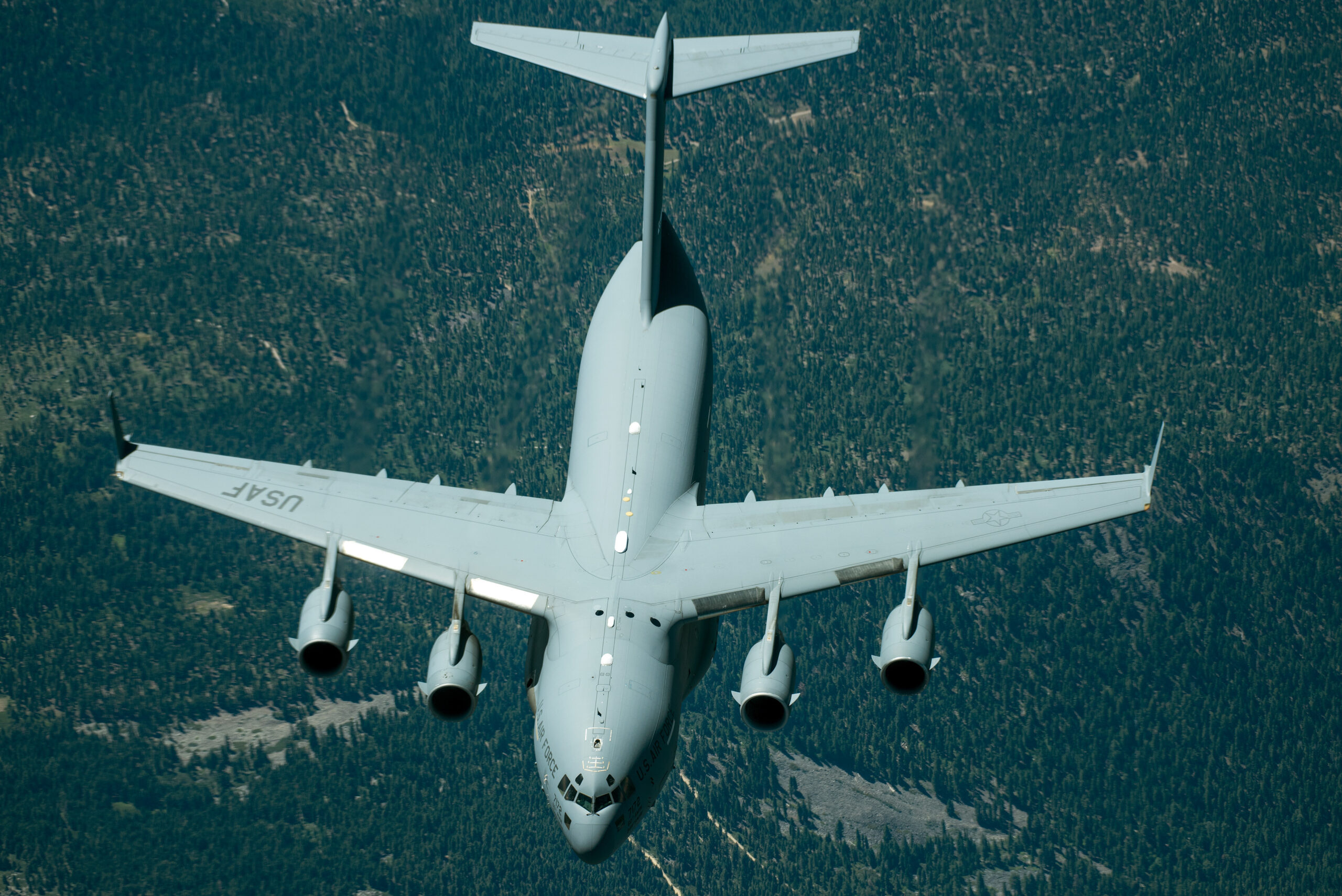
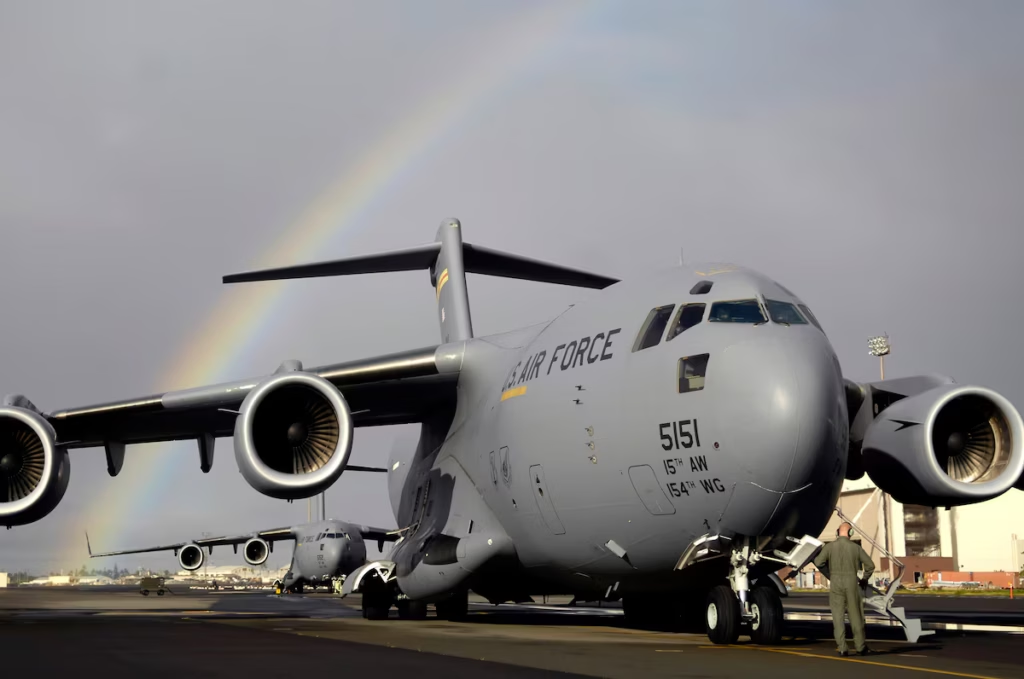
The C-17 Globemaster III is a large American military transport aircraft designed for both strategic and tactical airlift missions.
Developed initially by McDonnell Douglas and later produced by Boeing after the companies merged in 1997, the aircraft combines long-range cargo transport with the ability to operate from short and austere runways.
The aircraft first flew on September 15, 1991, and officially entered US Air Force service in 1995. Since then, it has become a cornerstone of the United States’ and several allied nations’ global military logistics.
How the C-17 Came to Be
By the late 1970s, the US Air Force needed a replacement for the aging Lockheed C-141 Starlifter while also reducing pressure on the larger C-5 Galaxy fleet. The military wanted an aircraft capable of transporting oversized cargo over long distances while still being able to land near front-line operations.
McDonnell Douglas based the design on its earlier YC-15 prototype transport aircraft developed during the Advanced Medium STOL Transport competition. Although the YC-15 never entered production, its concepts, especially short takeoff and landing performance, heavily influenced the future C-17.
Development proved difficult and expensive, with delays and cost overruns affecting the program during the 1980s and early 1990s. However, the aircraft eventually matured into one of the most successful military transport platforms of its generation.
How the C-17 Works
Key Features
Strategic Airlift Capability
The C-17 was designed to move heavy cargo across intercontinental distances quickly. It can transport armored vehicles, artillery, helicopters, pallets, and large troop contingents between theaters of operation.
Short Takeoff and Landing Performance
One of the aircraft’s defining strengths is its ability to land on short or semi-prepared runways. Unlike many large transport aircraft, the C-17 can operate from austere airfields much closer to combat zones or disaster areas.
Advanced Cargo Handling
The aircraft uses a rear-loading ramp and onboard cargo-handling systems that enable rapid loading and unloading. It can also conduct airborne airdrops of troops and equipment.
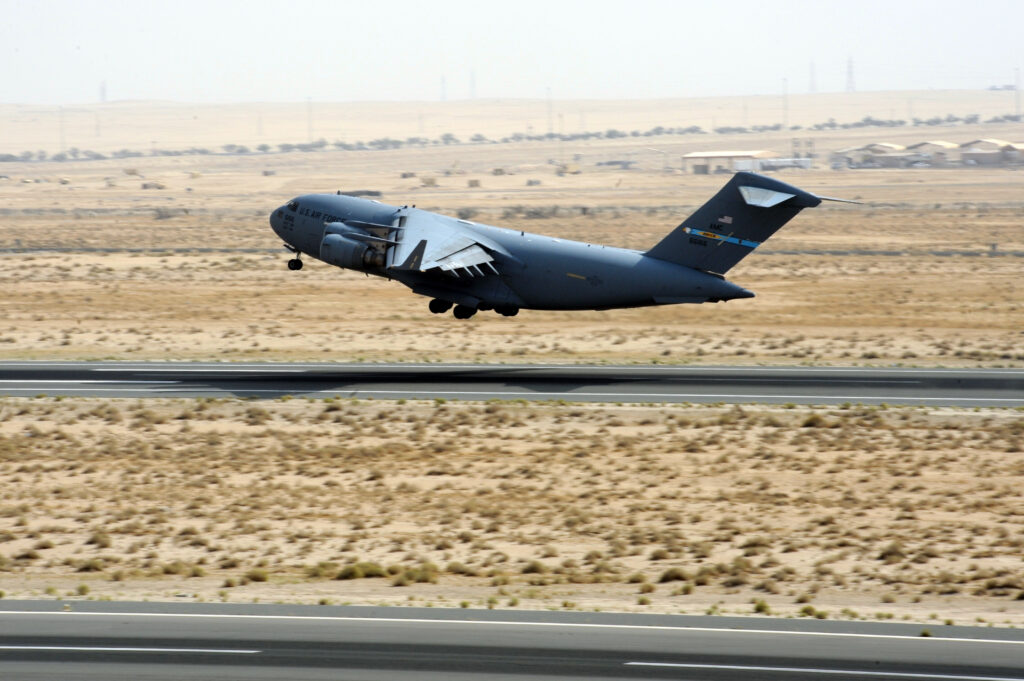
The C-17’s Strengths
- Exceptional flexibility: The aircraft bridges the gap between heavy strategic airlifters and smaller tactical transports. It can perform both long-range logistics missions and front-line delivery operations.
- High payload capacity: The C-17 can carry large military vehicles, including main battle tanks, making it one of the most capable transport aircraft ever fielded.
- Humanitarian operations: Beyond combat missions, the aircraft frequently delivers disaster relief supplies, evacuation support, and medical assistance worldwide.
- Emerging strike potential: Boeing has proposed a concept called the “Revolver:” an electromagnetic catapult system that would allow a C-17 to launch up to 12 hypersonic cruise missiles from its rear ramp. If developed, it could significantly expand the aircraft’s offensive role beyond pure logistics.
The C-17’s Limitations
- High operating costs: Operating a four-engine heavy airlifter is expensive, especially compared to smaller tactical transport aircraft.
- Large runway footprint: Although capable of short-field operations, the C-17 still requires more infrastructure than smaller aircraft like the C-130 Hercules.
- Halted production: Production officially ended in 2015, meaning future operators must rely on sustainment, upgrades, and secondhand airframes.
Global Use and Combat Operations
The C-17 has participated in nearly every major US and allied military operation since the 1990s, including missions in Afghanistan, Iraq, Kosovo, and Syria. It has also become heavily associated with humanitarian response missions after earthquakes, floods, and evacuations.
Countries operating the aircraft include the US, the UK, Australia, Canada, India, Qatar, and Kuwait.
The Strategic Airlift Capability is a separate multinational program established in 2008, through which 12 nations (Bulgaria, Estonia, Hungary, Lithuania, the Netherlands, Norway, Poland, Romania, Slovenia, Sweden, Finland, and the US) jointly own and operate three C-17s based at Pápa Air Base in Hungary.
Each member nation purchases a share of the available annual flight hours, which can be used for national, NATO, UN, or EU missions without requiring the unanimous agreement of all partners.
C-17 vs Competitors
| Aircraft | Country | Role | Key Strength |
| C-17 Globemaster III | US | Strategic/tactical airlift | Heavy payload with short-field capability |
| Lockheed C-130 Hercules | US | Tactical transport | Rugged operations and versatility |
| Ilyushin Il-76 | Russia | Heavy transport | Large cargo capacity |
| Airbus A400M Atlas | Europe | Tactical/strategic airlift | Modern avionics and fuel efficiency |
| Lockheed C-5 Galaxy | US | Strategic heavy airlift | Massive oversized cargo transport |
Future Outlook
Even though production has ended, the C-17 remains central to Western military airlift capability.
Boeing continues to support operators through sustainment and modernization programs, while several air forces are expected to keep the aircraft operational well into the 2040s.
As militaries increasingly focus on rapid deployment, humanitarian response, and dispersed operations, the C-17’s blend of strategic reach and tactical flexibility continues to make it indispensable.