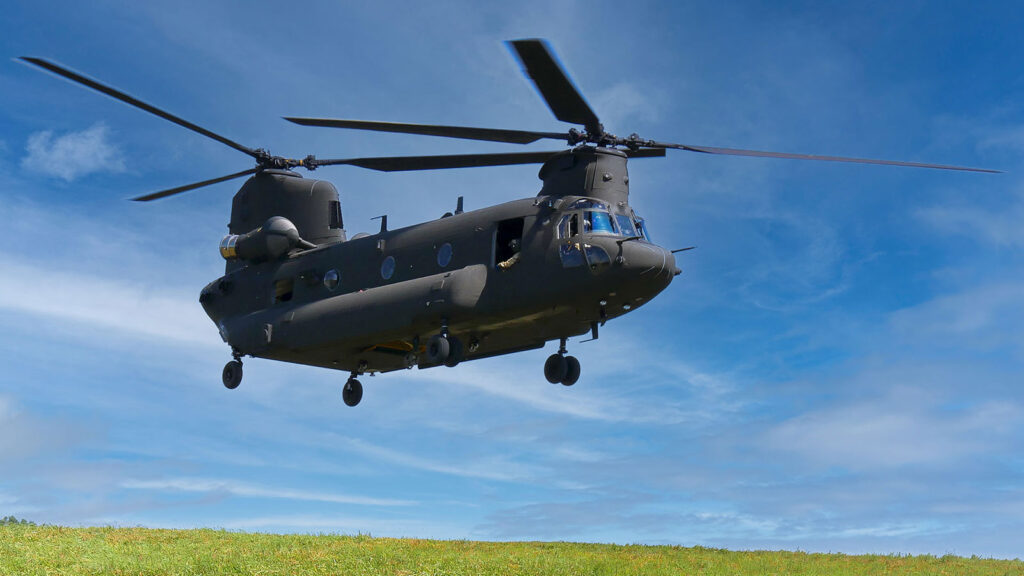
For more than six decades, the CH-47 Chinook has been one of the world’s most capable and recognizable heavy-lift helicopters.
Its distinctive tandem-rotor design, large payload capacity, and ability to operate in demanding environments have made it a cornerstone of military transport, supporting missions ranging from troop movements and cargo delivery to disaster relief and humanitarian assistance.
Today, the Chinook remains in service with armed forces around the world, continuing to evolve to meet modern operational demands. Here’s how it came to be, how it works, and why it remains a vital asset on today’s battlefield.
At a Glance
| Category: | Details: |
| Type | Twin-engine, tandem-rotor heavy-lift helicopter |
| Role | Cargo and troop transport, infiltration or extraction capabilities, search and rescue, special operations, and disaster relief |
| Manufacturer | Boeing |
| Propulsion | 2 x Honeywell T55-GA-714A engines (4,777 shaft horsepower each) |
| Rotor Diameter | 60 feet (18.3 meters) |
| Rotor Length | Folded: 50 feet (15.5 meters) Operating: 98 feet (30.1 meters |
| Overall Height | 18 feet (5.7 meters) |
| Fuel Capacity | 1,080 gallons (4,088 liters) |
| Maximum Speed | 170 knots (196 miles/315 kilometers per hour) |
| Cruise Speed | 181 miles (291 kilometers) per hour |
| Mission Radius | 190 miles (306 kilometers) |
| Maximum Gross Weight | 54,000 pounds (24,494 kilograms) |
| Fuselage | Length: 51 feet (15.6 meters) Width: 12 feet (3.8 meters) |
| Service Ceiling | 20,000 feet (6,096 meters) |
| Useful Load | 27,700 pounds (12,565 kilograms) |
What Is the CH-47 Chinook?
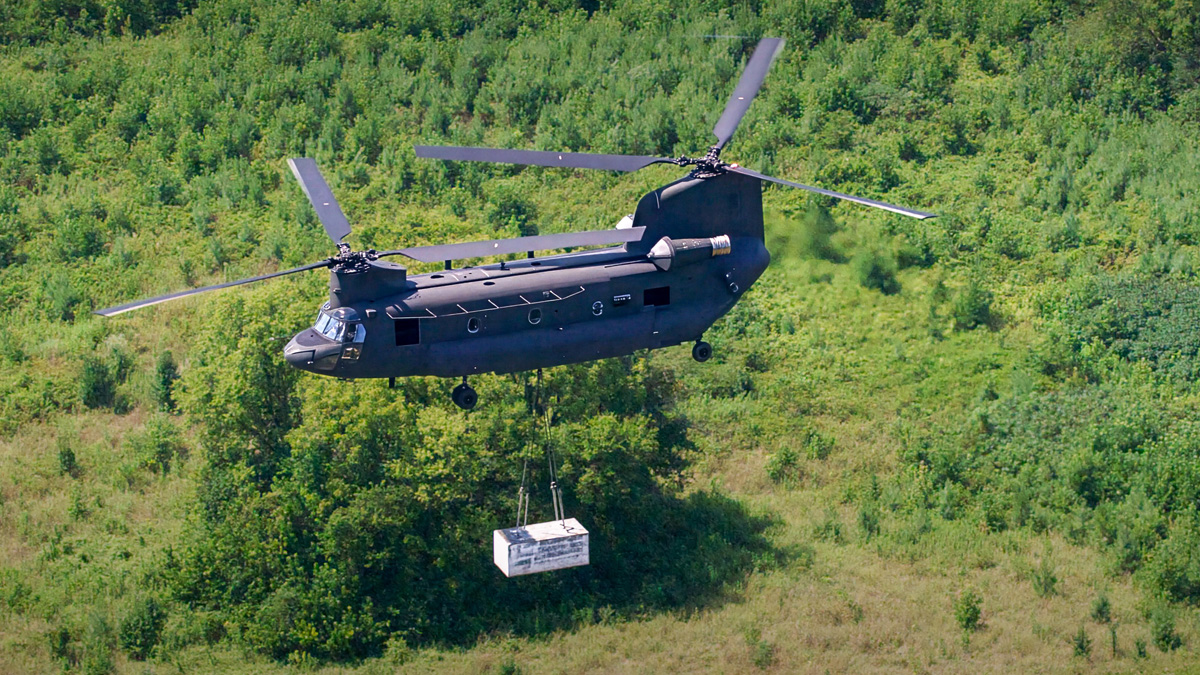
The CH-47 Chinook is a twin-engine, tandem-rotor heavy-lift helicopter developed by Boeing for troop transport, cargo movement, medical evacuation, logistical support missions, and special operations.
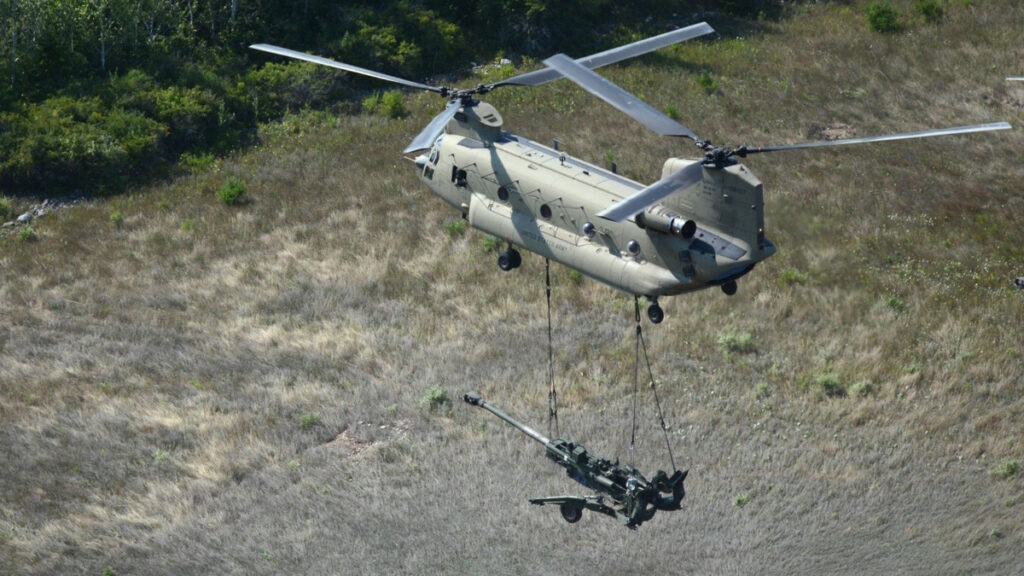
Originally designed for the US Army, the aircraft is capable of transporting personnel, military equipment, vehicles, and supplies across the battlefield. Its large cargo compartment and external sling-load capability make it one of the most versatile helicopters in military service.
Since entering service in the 1960s, the Chinook has become one of the world’s most widely used heavy-lift helicopters.
How the Chinook Came to Be
The US Army sought a helicopter capable of transporting larger payloads than existing aircraft, such as the CH-37 Mojave. The service needed a platform that could rapidly move troops and equipment while supporting increasingly mobile military operations.
Vertol, now part of Boeing, responded with a tandem-rotor design that eliminated the need for a tail rotor and maximized lifting power.
The resulting aircraft, designated the CH-47 Chinook, entered service in 1962. It quickly demonstrated its value during the Vietnam War, where it transported troops, artillery, supplies, and even damaged aircraft.
Over the following decades, the platform underwent continuous modernization, enabling it to remain operational despite dramatic changes in military technology and doctrine.
Key milestones:
- 1958: Development work started on the CH-47.
- 1961: The Chinook took its first flight.
- 1962: The first fully-equipped Chinook entered service in August.
- 1965: The Chinook began operational service in the Vietnam War.
- 1982: Boeing introduced the upgraded CH-47D variant, featuring more powerful engines, improved avionics, and increased payload capacity.
- 2000s: Introduction of the CH-47F, tagged as the world’s fastest military helicopter with a maximum speed of 196 miles (315 kilometers) per hour.
Chinook Variants
- CH-47A: The original production model introduced the tandem-rotor design and established the aircraft’s heavy-lift capabilities.
- CH-47D: Introduced extensive upgrades, including more powerful engines, improved avionics, and enhanced performance. This version became one of the most widely operated Chinook variants.
- CH-47F: The current standard US Army variant features upgraded avionics, a redesigned airframe, improved flight controls, and greater reliability.
- MH-47G: The special operations variant operated exclusively by the US Army’s 160th Special Operations Aviation Regiment, known as the Night Stalkers. It incorporates terrain-following radar, aerial refueling capability, advanced navigation systems, and extended fuel tanks for long-range low-level infiltration missions. The MH-47 family gained widespread public recognition after a modified variant was used during Operation Neptune Spear in May 2011 (the raid that killed Osama bin Laden) when one helicopter was lost on landing and deliberately destroyed by the assault team.
How the Chinook Works
Key Features
The Chinook’s defining feature is its tandem-rotor design, with one rotor mounted at the front and another at the rear.
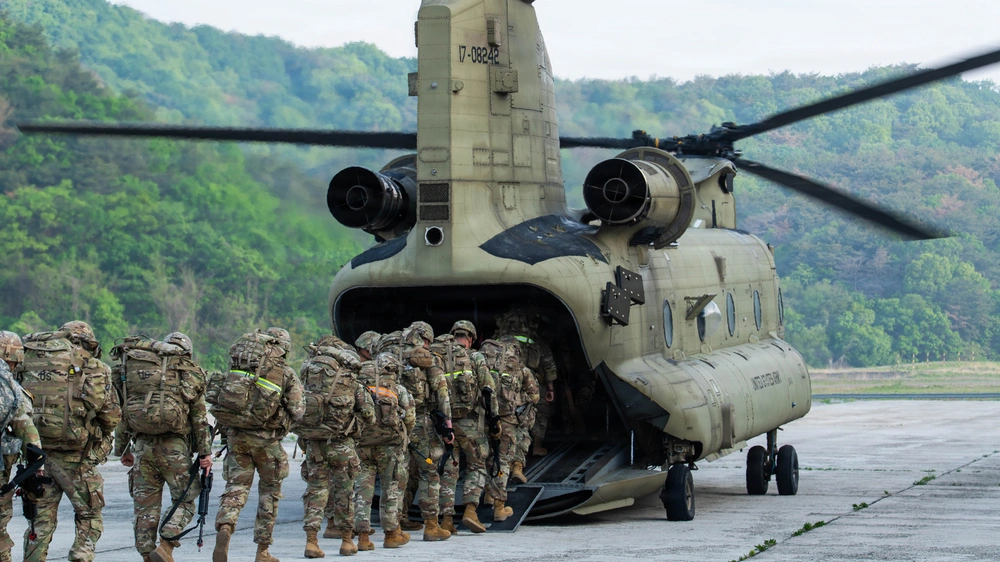
By eliminating the need for a tail rotor, the helicopter can channel more of its engine power into lifting heavy loads while maintaining impressive stability and control, even in strong winds. The configuration also enables operations at high altitudes and provides unobstructed access to the rear cargo ramp, allowing troops, vehicles, and equipment to be loaded and unloaded quickly in demanding environments.
Here are other core features:
- Heavy-lift capability: This is arguably the Chinook’s defining operational trait. It can carry dozens of troops or several tons of cargo, transport artillery, vehicles, ammunition, and supplies, and sling-load equipment beneath the aircraft.
- Rear loading ramp and cargo system: Often overlooked, but hugely important, this feature allows rapid loading and unloading of troops and cargo, accommodates vehicles, pallets, and oversized equipment, and enables quick turnaround times during combat and logistics missions.
Strengths
- High-speed performance: The Chinook is one of the faster helicopters in military service, which is one reason militaries continue to value it despite its age. Its cruise speed is significantly higher than many utility helicopters, and allows faster troop insertion, resupply, and casualty evacuation.
- Long-range and endurance: Particularly relevant for modern operations. The CH-47 can operate over long distances, support long-range air assault and logistics missions, and is further enhanced by aerial refueling on special operations variants.
- Operational flexibility: The aircraft can perform troop transport, cargo delivery, casualty evacuation, humanitarian assistance, and disaster-relief missions using the same basic airframe.
Limitations
- Large physical size: Its size can make operations in confined landing zones more challenging compared with smaller helicopters.
- Limited defensive capability: The Chinook relies primarily on escorts, defensive systems, and operational planning rather than offensive weaponry for protection.
Global Use and Combat Operations
The Chinook serves with numerous military operators worldwide, including the US, the UK, the Netherlands, Germany, Japan, South Korea, and several NATO allies.
From these, the Royal Air Force operates the largest fleet outside the US, with 54 Chinooks in active inventory as of 2025. The fleet is consolidating toward a planned force of 51 as older airframes are withdrawn, with 14 new-build H-47ER extended range variants on order.
RAF Chinooks have seen service in the Falklands War, the Balkans, Northern Ireland, Iraq, and Afghanistan; effectively every major British military operation since 1982.
The most storied individual airframe is Bravo November, a Chinook that was airborne when Argentine Exocet missiles sank the MV Atlantic Conveyor in May 1982, destroying the three other Chinooks aboard. Landing on HMS Hermes, it became the task force’s only heavy-lift helicopter for the remainder of the war. Bravo November is now preserved at the RAF Museum at RAF Cosford.
Chinooks have also participated in nearly every major US military operation since Vietnam, supporting troop deployments, cargo movement, special operations missions, and medical evacuations.
Yet its longevity has also prompted questions about how a design that first entered service in the 1960s can remain relevant on increasingly contested battlefields. In response, operators are fielding upgraded variants with improved payload capacity, survivability, and digital systems, while exploring new concepts such as manned-unmanned teaming and drone deployment from the aircraft itself.
Beyond combat, Chinooks have become invaluable for humanitarian assistance and disaster response, delivering emergency supplies and rescue personnel to areas affected by natural disasters.
Future Outlook
Few military aircraft can match the Chinook’s combination of longevity, versatility, and proven performance. Decades after its first flight, it continues to demonstrate why it remains one of the world’s premier heavy-lift helicopters.
However, the aircraft’s future effectiveness will increasingly depend on its ability to adapt to threats that have transformed modern warfare, including drones, precision-guided weapons, and sophisticated air-defense networks.
The US Army and international operators continue to invest in upgraded CH-47F models, ensuring the platform remains capable of supporting future military operations.
The most significant current modernization effort is the CH-47F Block II, which entered production in February 2024 and saw its first delivery to the US Army in June 2024.
Rather than a clean-sheet redesign, the Block II recapitalizes existing CH-47F airframes through an improved drivetrain, reinforced airframe, and redesigned fuel system — increasing maximum gross weight by approximately 4,000 pounds (1,800 kilograms) and extending mission radius across nearly all payload configurations.
The US Army has approved procurement through FY25 and FY26, with 18 Block II aircraft on order as of late 2025, and plans to eventually field up to 465 aircraft to the standard.
Boeing is also investing in further Block II enhancements, including autonomy features, open systems architecture, and a redesigned cockpit.
A potential Block III upgrade, incorporating a new 6,000-shaft-horsepower engine class under the Future Affordable Turbine Engine program and a lengthened fuselage, is being studied for a post-2025 introduction.
With the Future Vertical Lift program not expected to field medium-lift replacements until the mid-2030s at the earliest, the CH-47 is projected to remain in US Army service beyond 2060, making the Block II investment the critical bridge between today’s fleet and whatever comes next.