
Ukraine and Germany have signed an agreement to jointly develop anti-ballistic capabilities and interceptor missiles as part of a common European solution to counter increasingly sophisticated ballistic missile threats.
The initiative aims to combine Ukraine’s efforts to develop an indigenous anti-ballistic missile capability with European industrial expertise in next-generation missile defense technologies.
While no specific project has been named, the initiative could be linked to the Freyja anti-ballistic missile system being developed by Ukrainian firm Fire Point.
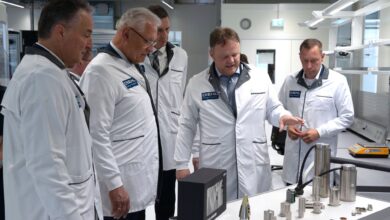
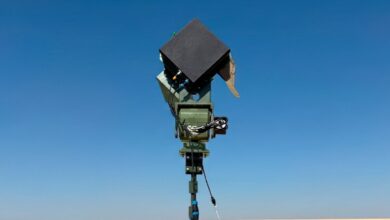
Just days before the signing, Fire Point and German sensor specialist Hensoldt entered into a strategic partnership to integrate Hensoldt’s TRML-4D radar into the Freyja system.
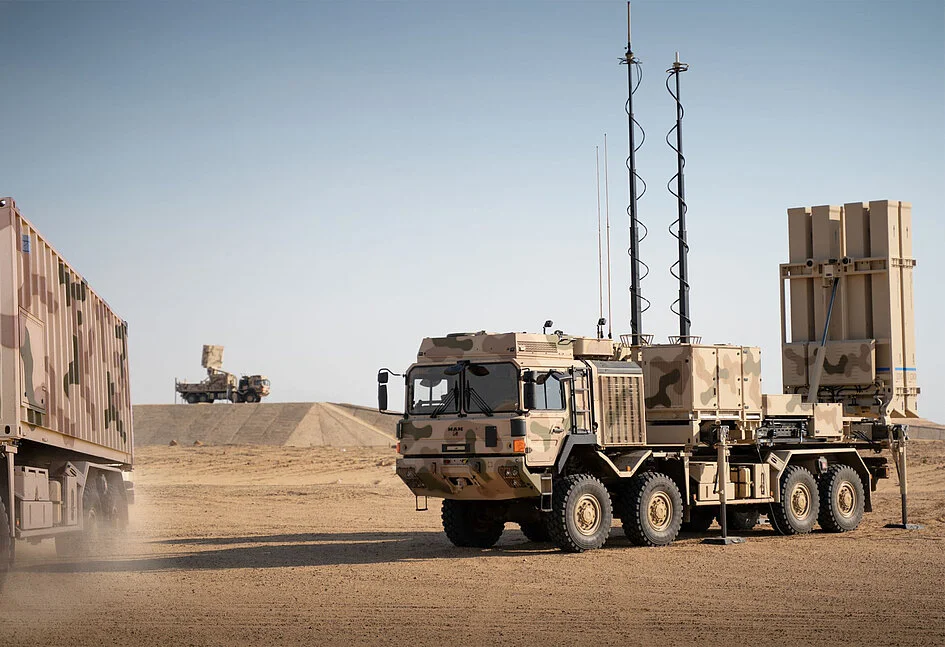
The TRML-4D is already in service with Ukraine, supporting the roughly 10 IRIS-T SLM air defense batteries operational in the country, as well as weapons-detection missions.
“The collaboration with Fire Point on Freyja is an important step towards a scalable European contribution to ballistic missile defense,” Hensoldt CEO Oliver Dörre said.
“Ukraine has shown how quickly innovation can emerge under real operational pressure. Our task is to combine this speed with proven sensor technology, industrial scalability, and system integration. Together with local manufacturers and European partners, we want to help close one of the most urgent capability gaps in air and missile defence.”
Project Freyja
Project Freyja comes amid significant advances in Ukraine’s domestic defense sector, which now provides around half of the country’s military requirements.
It also highlights Fire Point’s evolution from a manufacturer of long-range strike drones into a developer of increasingly sophisticated missile systems, including the FP-7 ballistic missile, which is reported to have a range of about 200 kilometers (124 miles).
Fire Point co-founder Denis Shtilerman previously described Freyja as a foundation for a future pan-European air and missile defense architecture, bringing together Ukrainian interceptor technology with European sensors, command-and-control systems, and missile-guidance components.
Features
At the center of Freyja is the FP-7.x interceptor, a derivative of the in-development FP-7 missile.
The interceptor’s reported speed of 1,500 to 2,000 meters (4,920 to 6,560 feet) per second suggests it is intended to engage high-speed ballistic threats, provided it is paired with sufficiently advanced sensors and guidance systems.
It is equipped with an imaging infrared seeker, while the company is also evaluating the integration of a semi-active seeker from Diehl Defence.
For target tracking and fire control, developers are evaluating the Weibel GFTR-2100/48 and Leonardo KRONOS Land radar systems, while Kongsberg’s Fire Distribution Center is planned to serve as the command-and-control node.
A lightweight domestically developed mobile launcher is expected to act as the launch platform.
A key element of the design is the incorporation of the Link 16 tactical data link, which would facilitate integration with Ukraine’s broader air and missile defense network.