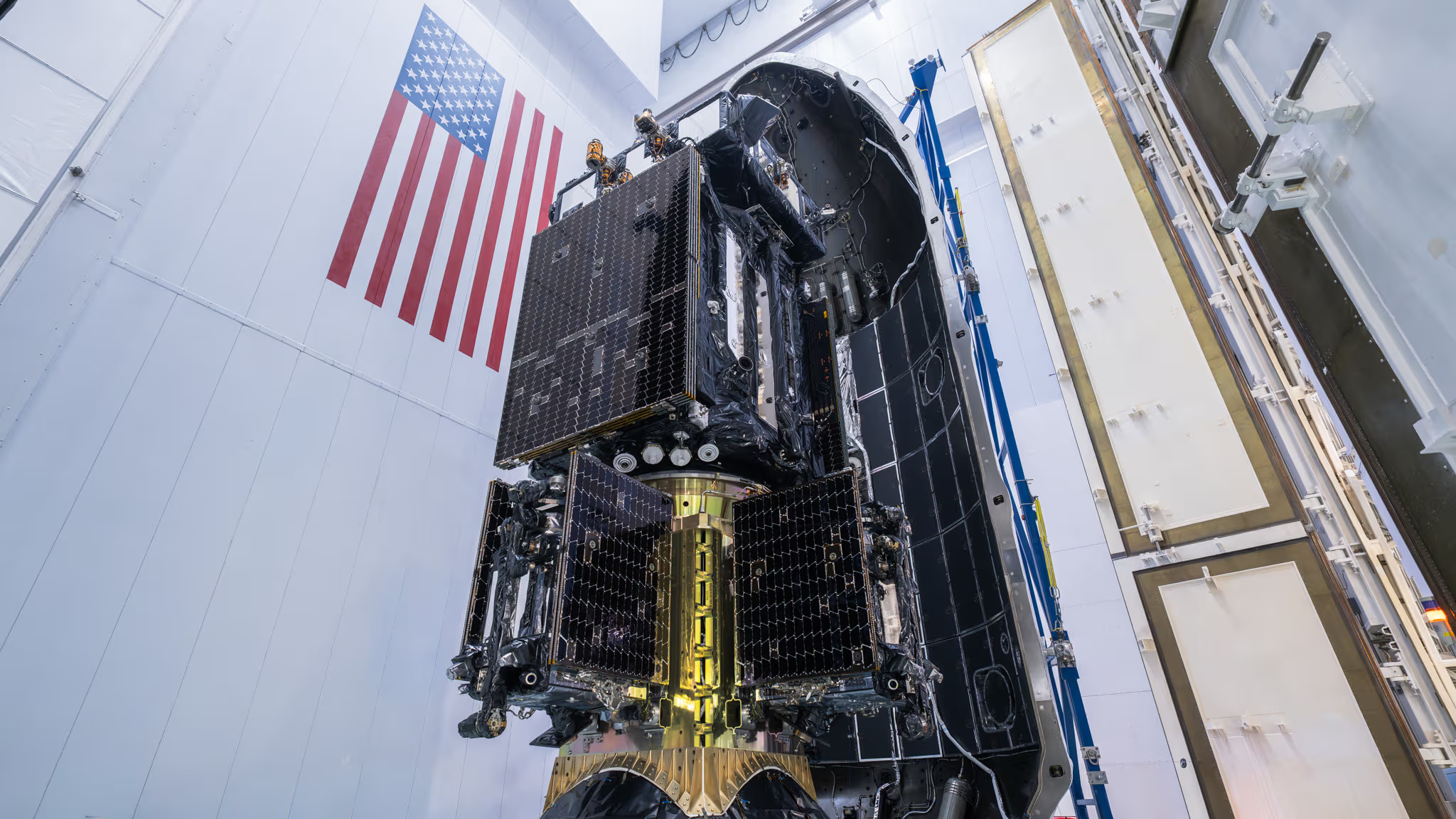
Northrop Grumman has launched its Mission Robotic Vehicle (MRV), marking a major step toward operational satellite servicing and life-extension missions in orbit.
The spacecraft, which lifted off alongside three Mission Extension Pods (MEPs), introduces a new generation of autonomous systems designed to inspect, relocate, repair, upgrade, refuel, and extend the operational life of satellites.
The MRV combines Northrop Grumman’s rendezvous, proximity operations, and autonomous docking technologies with a robotics payload developed by the US Naval Research Laboratory. Equipped with two articulated robotic arms and specialized tools, the vehicle is designed to perform a wide range of in-space servicing tasks.
MEPs, meanwhile, function as propulsion modules that can attach to satellites nearing the end of their fuel supply.
The MRV also launched with the first Passive Refueling Module, a US Space Force-approved docking and refueling interface designed to allow future on-orbit refueling.
Ryan Tintner, vice president and general manager for space superiority at Northrop Grumman, said the platform represents a new class of autonomous space robotics capable of supporting increasingly complex missions.
“Our world-leading investments in these capabilities are finally providing options in space that are only limited by our imagination,” he said.
Northrop Expands Space Portfolio
The MRV follows several Northrop Grumman contracts and programs focused on expanding its space capabilities.
In June, the company secured a $398-million contract to develop an Enhanced Protected Tactical Satellite Communications prototype to strengthen defense against jamming and cyber threats.
Earlier, in April, the company launched the Space Test Program-S29A mission aboard its Minotaur IV rocket, deploying multiple experimental payloads to support space-based research and improve domain awareness for military operations.
The effort builds on the August 2025 demonstration of the Deep-Space Advanced Radar Capability in Western Australia, where Northrop Grumman and the US Space Force tested a next-generation radar designed to precisely detect and track objects in deep space.