The US Navy has awarded Raytheon a $1.8-billion contract extension for SPY-6 radar hardware production and sustainment.
The award builds on the initial hardware production and sustainment contract awarded in March 2022 and includes options that, if exercised, would increase the cumulative contract value to $3.3 billion.
“This contract extension reflects the Navy’s confidence in our ability to deliver advanced, reliable and scalable radar solutions,” Raytheon Naval Power President Barbara Borgonovi said.
“Our continued investment and commitment to ramping production will ensure the fleet has the sensing advantage to stay ahead of evolving threats for decades to come.”
Work is expected to be completed by July 2031. If all options are exercised, performance will continue through October 2031.
Backed by more than a decade of development and operational testing, the SPY-6 radar is supported by more than $800 million in manufacturing investments, with Raytheon aiming to double production by 2028.
SPY-6 Radar
The SPY-6 radar family comprises four scalable variants that provide 360-degree coverage against cruise missiles, ballistic missiles, aircraft, surface threats, and electronic attacks.
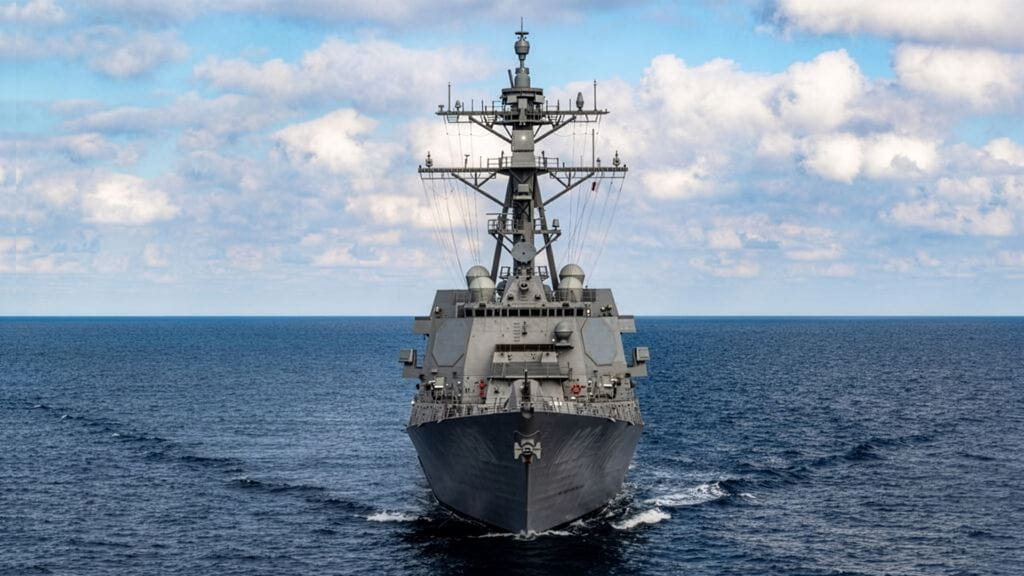
Built around Radar Module Assemblies (RMAs), the SPY-6(V)1 for Flight III Arleigh Burke-class destroyers features four arrays with 37 RMAs each, while the SPY-6(V)4 for Flight IIA destroyers uses four arrays with 24 RMAs. Both support integrated air and missile defense and electronic warfare missions.
The SPY-6(V)2, featuring a single rotating array, is designed for amphibious assault ships and Nimitz-class aircraft carriers, while the SPY-6(V)3 employs three fixed arrays for Ford-class carriers.
The SPY-6 is already deployed on two commissioned US Navy ships and is installed on 11 more that are undergoing testing.
Over the next decade, the radar is expected to equip more than 50 vessels, including Flight III Arleigh Burke-class destroyers, aircraft carriers, and amphibious warships, enhancing the fleet’s ability to detect and track advanced air and missile threats.