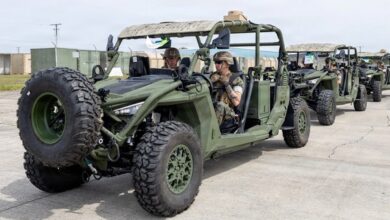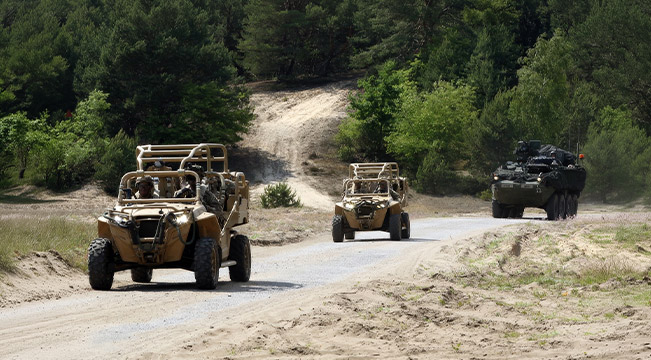

Belgium has awarded Polaris Government and Defense a $10.6-million contract to supply MRZR D4 tactical all-terrain vehicles (ATVs) for the Belgian Special Operations Regiment.
Designed for tactical mobility in complex terrain and contested environments, the vehicles are intended to replace Belgium’s aging Groundhog vehicle fleet, which has been in service since 2009.
The delivery timeline has not been disclosed.
“With these new vehicles, we are significantly increasing our mobility and operational capabilities,” Commander of the Belgian Special Operations Regiment, Colonel Kristof Van Poecke, said.
“They enable our operators to respond more quickly and flexibly in challenging conditions, where speed and manoeuvrability make the difference. This is an important step to maintain our operational capacity at the highest level.”
Framework Contract
Brussels placed the order under a NATO Support and Procurement Agency (NSPA) framework agreement awarded in September 2025 that streamlines the acquisition process by eliminating additional trials and competitions.
In addition to bulk pricing benefits and expedited procurement, the NSPA promotes interoperability and standardization while reducing the logistics footprint across NATO members and partner nations.
“The Belgian Ministry of Defence helped establish the MRZR D on the framework contract, with additional partner countries including the United Kingdom,” Senior Manager for Europe, the Middle East, India, and Africa at Polaris Government and Defense, Steve Canner, said.
“The vehicle’s capabilities and commonality with other NATO nations will serve Belgium forces very well, and we’re proud to support them.”
MRZR D4 ATV
Introduced in 2012, the MRZR platform has been continuously upgraded to meet evolving US military requirements and is in service with more than 50 allied forces worldwide in gasoline and diesel variants.
The combat-proven MRZR D4 features a modular design with a collapsible roll cage for internal air transport, on-demand all-wheel drive, a one-meter (3.28-foot) water-fording capability, and a 1,500-pound (680-kilogram) payload capacity.
Powered by a 55-horsepower turbo-diesel engine, it can carry four personnel and has an operational range of up to 200 miles (322 kilometers).
Transportable aboard AW101 Merlin, CH-47 Chinook, and V-22 Osprey aircraft, as well as most fixed-wing aircraft and maritime vessels, the vehicle supports rapid deployment in austere environments.
It can be configured for personnel transport, casualty evacuation, command and control, and light cargo missions. The platform has also been integrated with counter-drone, intelligence, surveillance, and reconnaissance, communications, autonomy, medical evacuation, and weapons systems.