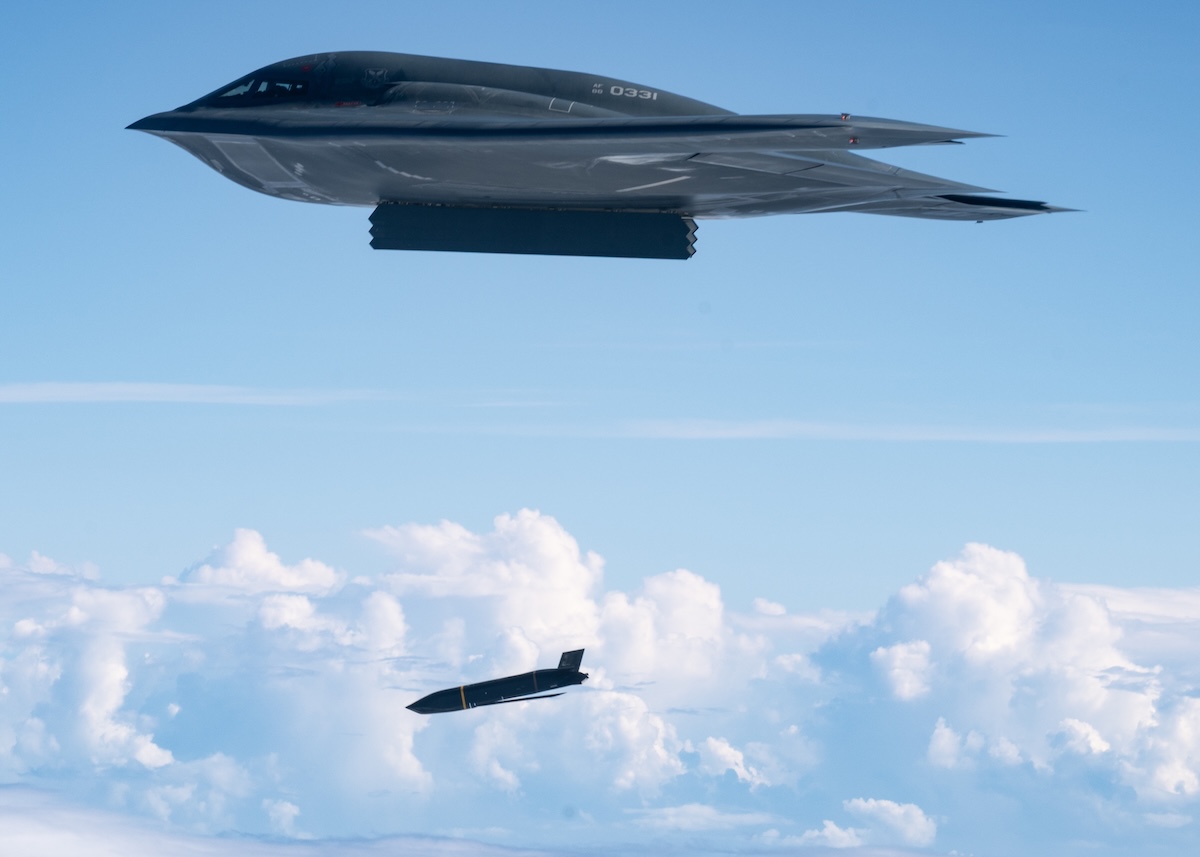
A US Air Force B-2 Spirit has successfully deployed the Long Range Anti-Ship Missile (LRASM) during a live-fire exercise in the Pacific, marking the service’s first time publicly disclosing the pairing.
The AGM-158C LRASM, developed by Lockheed Martin, was designed to destroy high-value naval targets in anti-access/area-denial (A2/AD) environments without relying on constant external guidance.
It was not previously revealed to have been part of the stealth bomber’s arsenal, which includes the B61 nuclear gravity bomb, the bunker-busting GBU-57A/B Massive Ordnance Penetrator, Joint Direct Attack Munitions, and the Joint Air-to-Surface Standoff Missiles (JASSM).
The B-2 conducted the strike against the decommissioned Austin-class amphibious transport dock USS Juneau (LPD 10) during a demonstration at Sinking Exercise — a training event where decommissioned, obsolete, or captured vessels are used as targets — north of the Mariana Islands.
“By prioritizing counter-maritime strike operations, we can maintain a decisive edge over adversaries, protect our national interests and ensure the free and open Pacific that underpin our global security,” said General Kevin B. Schneider, Pacific Air Forces Commander.
Long-Range Maritime Strike
The stealthy and precision-guided LRASM is a maritime, anti-ship derivative of the JASSM, which was designed for fixed and relocatable land targets.
LRASM uses passive sensors and on-board autonomous targeting and navigation features, and it travels at ranges exceeding 200 nautical miles (230 miles/370 kilometers).
Its launch platforms include the US Air Force’s B-1B Lancer and the US Navy’s F/A-18E/F Super Hornet.
Meanwhile, integration is underway on the F-35C and F-16 fighters, as well as the P-8 Poseidon maritime patrol aircraft.
In March, the air force contracted Lockheed Martin to increase production of the long-range strike weapon.