The TDP Gap: How AI Reverse Engineering Is Changing Defense Sustainment
Legacy military platforms are maintained against technical data packages that are incomplete, restricted or simply missing. The tools to close that gap without a scanner or a drawing office are now available in the field.

The Technical Data Package (TDP) is the foundation of defense sustainment. Every component on a military aircraft, vehicle, or platform is supposed to have one: a complete set of engineering data — drawings, specifications, material callouts, tolerances — sufficient to reproduce that component to its original design intent.
In practice, the TDP is often incomplete, restricted to the original manufacturer, classified at a level that limits access, or was never compiled in a form compatible with modern engineering tools.
This is a well-understood and growing challenge. The gap between the documentation that exists and the document that sustainment engineers need has widened. The inventory of legacy platforms expands as aircraft operating decades beyond their original design life and vehicles are sustained through multiple upgrade cycles.
The consequence is that technicians and engineers working on these platforms frequently encounter parts with no usable digital model. The response, as it has been for decades, is manual reverse engineering.
The Cost of Working Around the TDP Gap
Manual reverse engineering of a single component involves measurements, sketches, computer-aided design (CAD) reconstruction, and more. It can take several hours even under ideal conditions. In a depot-level sustainment program managing hundreds of line items with degraded or missing technical data, costs compound quickly.
3D scanning offers a partial solution but introduces constraints of its own: the need for specialist equipment, trained operators, and controlled environments. For forward-deployed maintenance and field-level sustainment, a high-end scanner is rarely available at the point of need.
The Technical Airworthiness Publication System (TAPS), which governs airworthiness documentation for US Army aviation and related platforms, imposes a further requirement: that maintenance and repair activities are performed in accordance with approved technical data.
When that data does not exist or is inaccessible, the sustainment engineer is working in both a compliance gap and an engineering one. Reproducing a part without an approved TDP is not simply a technical challenge. It is a readiness and certification challenge.
What AI Changes for Field Sustainment
AI has created a practical workaround for the scanning constraint without compromising output quality.
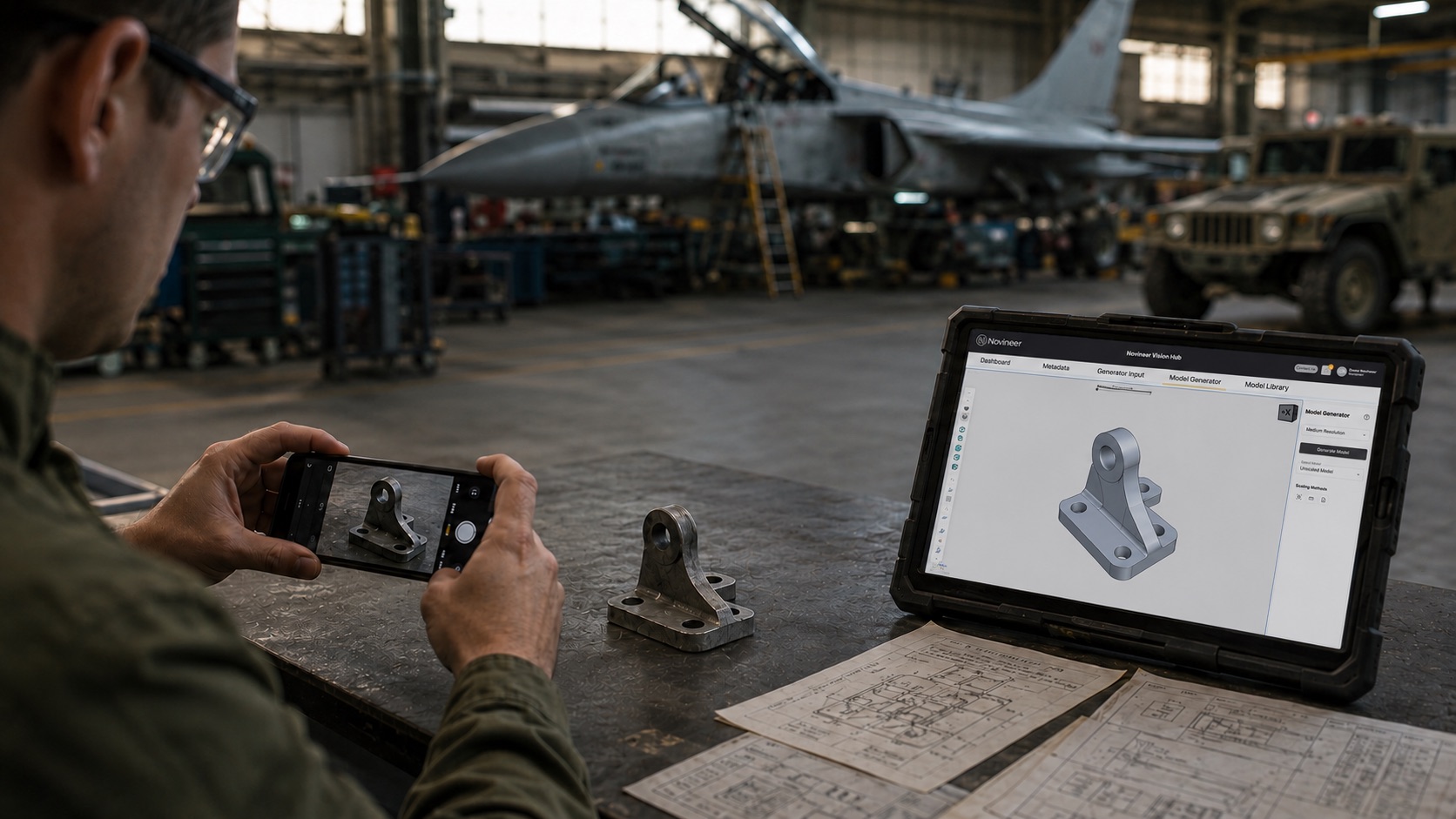
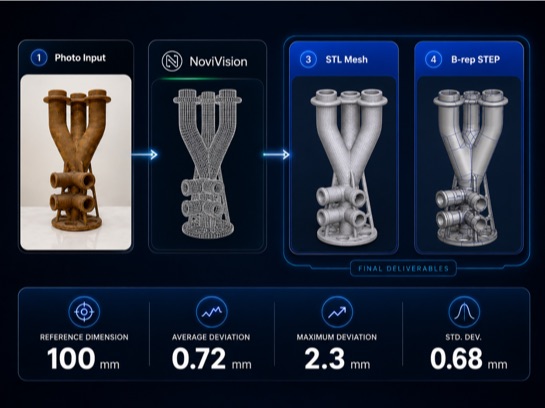
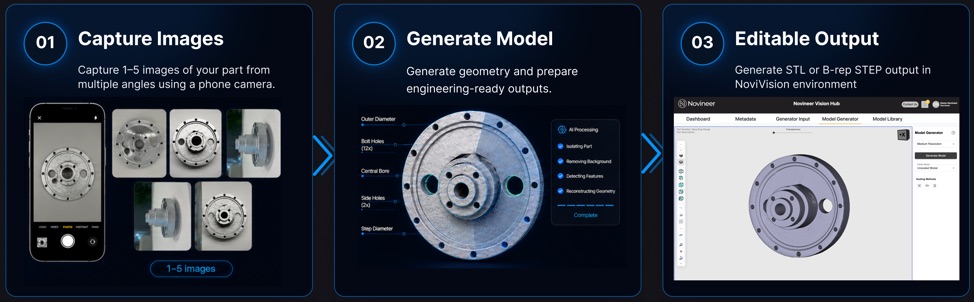
This is the approach behind NoviVision, the AI reverse engineering platform we have developed at Novineer: photograph the component from one to four angles with a smartphone, and the software generates an editable CAD file in around two minutes. It is deployable at the point of need. No scanner, no calibration rig, no specialist operator. Just a smartphone and the component to be reverse-engineered.
We have validated this workflow to an average error of 0.72mm on a 100mm reference part, and a maximum error of 2.3mm. For the majority of sustainment reverse-engineering tasks — quoting, fit checks, redesign feasibility, field manufacturing preparation — that accuracy is sufficient.
For tight-tolerance components requiring precision metrology, a high-end scanner remains the appropriate tool. The point is not to replace it universally but to remove it as a dependency for the 80 percent of cases where it is not needed.
The output is an editable STEP file, which is the standard format for CAD exchange, compatible with the engineering environments used across defense manufacturing and sustainment. It enters the digital workflow directly, without intermediate conversion.
For a program working towards digital thread compliance under Department of Defense digital engineering mandates, a model that did not exist yesterday and exists today is not a minor efficiency gain but rather a data asset for the platform record.
The technology behind NoviVision draws on more than 15 years of federally funded research, supported by NSF, AFOSR, NASA and the Office of Naval Research, and Novineer has established corporate agreements with defense organizations including the US Army.
From Reverse Engineering to the Digital Thread
The TDP gap is most visible as a maintenance problem. Its implications are broader.
A legacy component with no usable digital model cannot be simulated for structural performance, optimized for additive manufacturing as a replacement strategy, or incorporated into a digital twin of the platform it belongs to.
The absence of a CAD model is not just an inconvenience for the engineer on the shop floor. It is a gap in the platform’s digital record that compounds over time.
AI reverse engineering closes that gap early: before the component fails, before a vehicle is deadlined, before a system becomes non-mission-capable, and before a small legacy part turns into a readiness problem.
Once the model exists, the downstream tools can be applied: toolpath-aware structural simulation through NoviPath, which is integrated with Stratasys GrabCAD Print Pro and is helping early customers achieve weight reductions of 35 percent in additively manufactured parts and generative redesign of obsolete components through NoviDesign. Without the model, none of this is possible.
The Pace the Mission Requires
Defense sustainment operates on timelines that commercial MRO does not. An aircraft on the ground at an operational base has a different urgency than one at a commercial line station.
Dependence on specialist scanning equipment and drawing office support has persistently limited early MRO assessment time, but Novineer reports that NoviVision can reduce this by more than 80 percent.
AI-powered reverse engineering is ready for operational use. The accuracy is validated, the output format is standard, the deployment model requires no infrastructure beyond a smartphone and a network connection. The question is how quickly organizations can update the workflows, approvals, and technical data governance processes built around the old constraints.
Those constraints are not fixed. The TDP gap is not a permanent feature of legacy platform sustainment. It is a problem that the technology now exists to address, at the point of need, at the speed the mission requires.

Dr. Ali Tamijani is the Founder and CEO of Novineer, Inc., and a Professor of Aerospace Engineering at Embry-Riddle Aeronautical University. His work has long focused on reducing friction between physical parts and digital engineering systems, and Novineer is the commercial expression of that vision.
Dr. Tamijani earned his Ph.D. in Engineering Mechanics from Virginia Tech in 2011 and joined Embry-Riddle in 2013. Since then, he has built a leading research program in structural optimization and design for additive manufacturing, securing more than $2.5 million in federal funding from NSF, AFOSR, NASA, and the Office of Naval Research. His honors include the AFOSR Young Investigator Award (2017), the NSF CAREER Award (2019), and Embry-Riddle’s Outstanding Researcher of the Year Award (2020).
In 2022, he founded Novineer to commercialize technologies developed and validated through more than 15 years of federally funded research. The company’s AI-powered software provides solutions for reverse engineering, generative design, and toolpath-aware simulation through NoviVision, NoviDesign, and NoviPath, enabling engineers to move from real-world parts and performance requirements to production-ready digital models faster, more affordably, and with less risk.
Under Dr. Tamijani’s leadership, Novineer has gained support from the US Air Force, NSF, and the Office of the Secretary of Defense, formed strategic partnerships with OEMs such as Stratasys, and established corporate agreements with defense organizations including the US Army. NoviPath is integrated with Stratasys’ GrabCAD Print Pro as part of a strategic partnership.