Before drones and long-range precision weapons came to define modern warfare, armored vehicles were already reshaping how armies fought on the ground.
Among the most influential was the Bradley infantry fighting vehicle — a platform designed not just to carry troops, but to fight beside tanks in high-intensity combat.
Despite early controversy over its design and survivability, decades of combat operations transformed it into one of the US military’s most recognizable and battle-tested armored platforms.
This guide explores Bradley’s development, variants, combat role, operational history, and future.
At a Glance
| Category: | Details: |
| Type | Infantry fighting vehicle |
| Role | Troop transport, reconnaissance, fire support, anti-armor warfare |
| Manufacturer | BAE Systems (originally developed by FMC Corporation) |
| Crew | 3 (commander, gunner, driver) |
| Troop Capacity | 6 to 7 infantry soldiers |
| Combat Weight | Approximately 27 to 36 tons (depending on variant) |
| Armament | Main: 25mm M242 Bushmaster chain gunSecondary: BGM-71 TOW anti-tank missiles, 7.62mm coaxial machine gun |
| Engine | Cummins VTA-903T diesel engine |
| Maximum Speed | Approximately 56 kilometers/35 miles per hour |
| Operational Range | Approximately 400 kilometers (249 miles) |
| Armor Protection | Aluminum armor with steel laminate and reactive armor upgrades on later variants |
| Key Variants | M2 Infantry Fighting Vehicle, M3 Cavalry Fighting Vehicle, A2/A3 upgraded variants |
| Notable Features | Combined troop transport and anti-tank capability, tracked mobility, TOW missile integration, digital battlefield upgrades |
What Is the Bradley IFV?
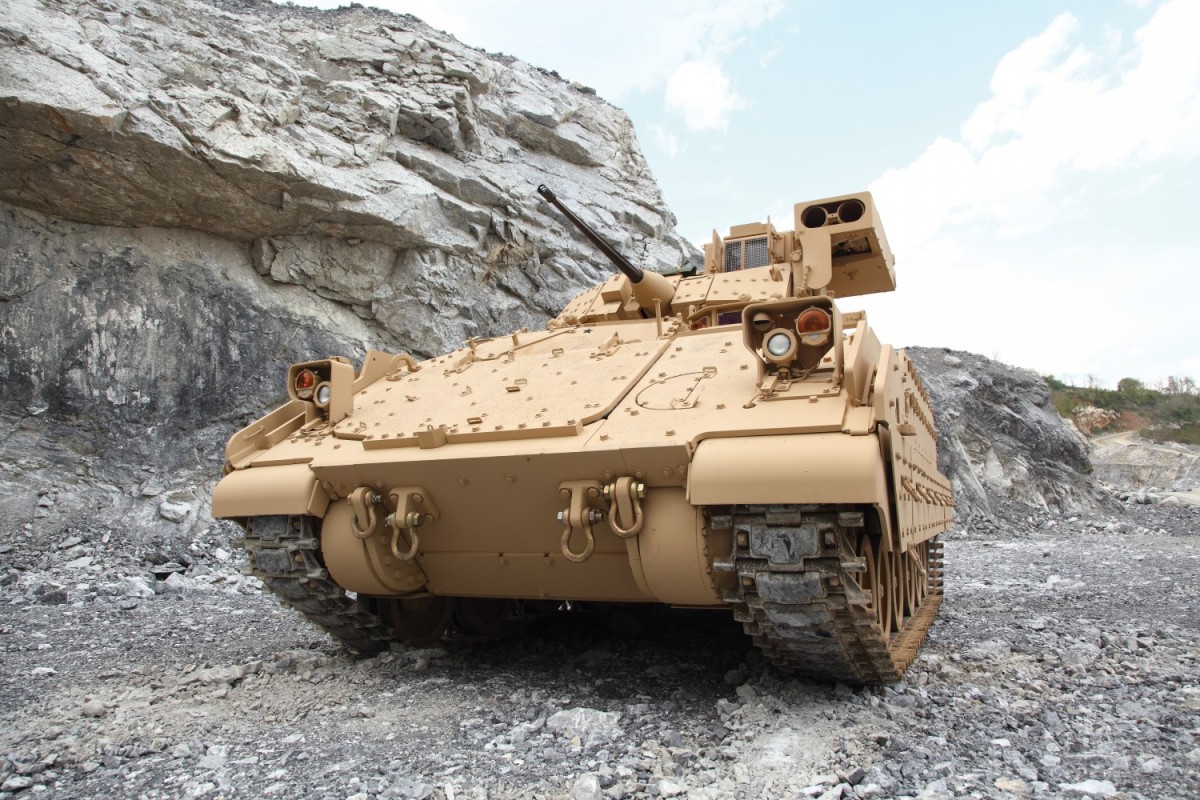
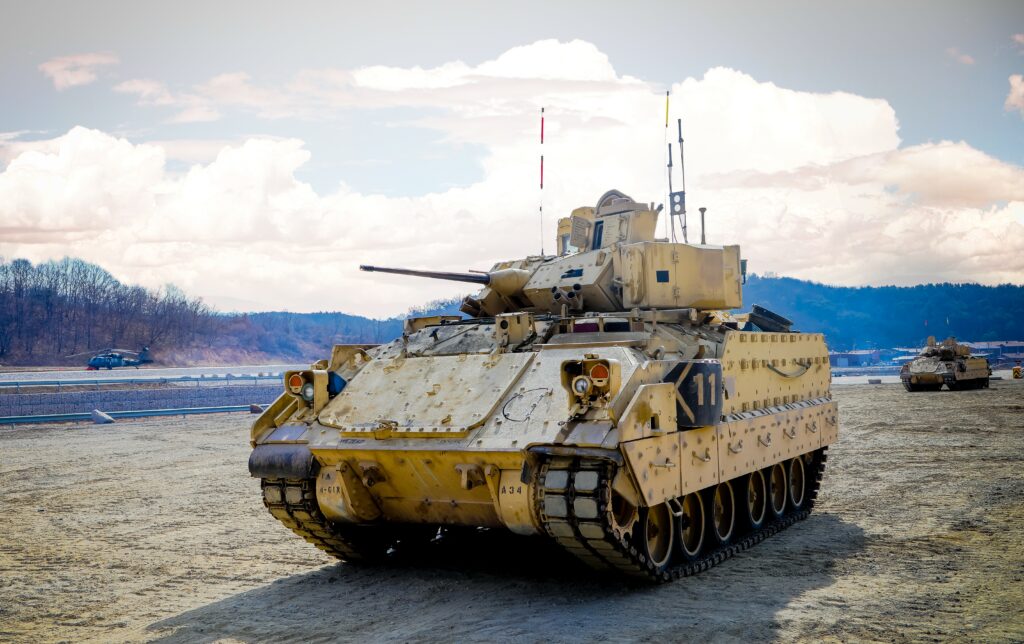
The Bradley infantry fighting vehicle (IFV) is a tracked armored combat vehicle designed to transport infantry while providing direct fire support on the battlefield.
Unlike armored personnel carriers that mainly move troops, the Bradley was built to actively engage enemy armor, infantry, and fortified positions. The platform was developed primarily by FMC Corporation, whose defense division later became part of BAE Systems.
The Bradley serves multiple battlefield functions, including troop transport, reconnaissance, anti-armor warfare, and command support. It remains one of the US Army’s core armored vehicles.
How the Bradley Came to Be
Cold War Origins
The Bradley program emerged during the 1960s and 1970s as the US military sought a vehicle that could operate alongside main battle tanks in high-intensity warfare.
American planners were heavily influenced by Soviet infantry fighting vehicles such as the BMP series, which combined troop transport with offensive firepower. The US wanted a platform capable of carrying infantry while also surviving and fighting in mechanized battles.
Development Challenges
The Bradley program faced years of delays, redesigns, and withering criticism — most of it deserved.
The vehicle’s development became one of the most public procurement disasters in Pentagon history, immortalized in James Burton’s book The Pentagon Wars and later an HBO film of the same name.
Burton, an US Air Force colonel assigned to oversee the program, documented how the Bradley had been redesigned so many times — adding armor, then missiles, then more armor — that it had become dangerously overweight and compromised as both a troop carrier and a fighting vehicle.
His central argument was brutal: the US Army had produced a vehicle too lightly armored to survive a hit and too heavy to do what a troop carrier was supposed to do.
Congressional hearings followed. Live-fire tests were manipulated. The whole episode became a case study in how defense procurement could go catastrophically wrong when institutional inertia overrode honest engineering assessment.
Despite all of it, the vehicle entered service in 1981 and eventually proved its critics at least partially wrong in the Gulf War, where it destroyed more Iraqi armored vehicles than the M1 Abrams did.
Bradley IFV Variants
M2 Bradley Infantry Fighting Vehicle
The M2 is the standard variant built to move troops into combat while fighting alongside tanks on the front line.
Unlike traditional armored personnel carriers designed mainly for transport, the M2 combines troop mobility with the firepower to engage enemy forces directly during mechanized operations.
Armed with a 25mm M242 Bushmaster chain gun and tube-launched, optically tracked, wire-guided (TOW) anti-tank missiles, the Bradley can engage enemy infantry, light armor, fortified positions, and even main battle tanks at range.
M3 Bradley Cavalry Fighting Vehicle
The M3 was developed for armored reconnaissance and scouting missions rather than infantry transport.
While externally similar to its predecessor, the M3 sacrifices troop-carrying capacity in favor of additional ammunition, communications systems, surveillance equipment, and reconnaissance tools.
Its mission is to move ahead of larger armored formations, identify enemy positions, monitor battlefield movement, and relay targeting information back to commanders. The vehicle’s sensors, optics, and firepower allow reconnaissance crews to gather intelligence while still defending themselves against hostile forces.
Bradley A2 and A3 Upgrades
As battlefield threats evolved, the Bradley platform underwent major modernization efforts through the A2 and A3 upgrade programs.
The Bradley A2 introduced improved armor protection, enhanced mobility systems, upgraded fire suppression equipment, and better survivability against mines and anti-armor weapons.
These upgrades reflected lessons learned from modern combat environments where improvised explosive devices and anti-tank missiles became increasingly common threats.
The later A3 variant focused heavily on digital warfare and battlefield connectivity. It added advanced thermal-imaging systems, improved targeting sensors, integrated battlefield management software, and enhanced communications networks.
Key Features
Heavy Firepower
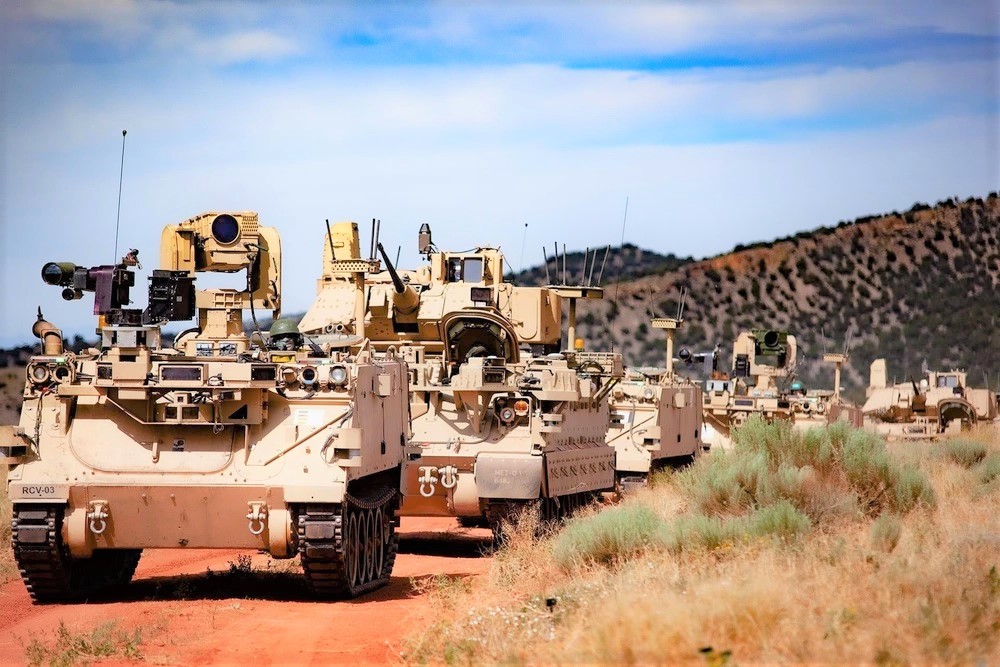
The Bradley is armed with the M242 Bushmaster 25mm chain gun, capable of engaging infantry, light armor, and aerial threats. It also carries TOW anti-tank guided missiles for destroying heavily armored vehicles.
Troop Transport Capability
The vehicle can transport infantry squads while protecting them from small arms fire, artillery fragments, and battlefield hazards.
Tracked Mobility
Its tracked design allows the Bradley to operate across rough terrain, mud, and damaged urban environments alongside tanks.
Strengths
- Combined-arms flexibility: The Bradley bridges the gap between armored vehicles and infantry support, enabling mechanized forces to move and fight together effectively.
- Anti-armor capability: TOW missiles give the vehicle significant firepower against enemy tanks and fortified positions.
- Combat-proven platform: The Bradley has been extensively used in combat operations across Iraq and other conflict zones, driving continuous upgrades informed by battlefield experience.
Limitations
- Vulnerability to heavy weapons: Although heavily armored for its class, the Bradley remains vulnerable to anti-tank missiles, mines, and large-caliber weapons.
- Internal space constraints: Troop capacity is limited compared with some modern infantry fighting vehicles.
- Aging platform: Despite upgrades, the Bradley’s core design dates back decades, prompting the US Army to seek eventual replacements.
Global Use and Combat Operations
The Bradley gained global recognition during the 1991 Gulf War, where it demonstrated strong mobility and anti-armor capabilities against Iraqi forces.
The vehicle later saw extensive deployment during the Iraq War and operations in Afghanistan, often supporting urban combat and counterinsurgency missions.
The most compelling validation of the Bradley’s anti-armor capability came not in Iraq but in Ukraine.
In January 2024, near Avdiivka, drone footage captured a pair of Ukrainian M2 Bradleys engaging a Russian T-90M, one of Moscow’s most advanced main battle tanks. The Bradley won.
The crews inflicted enough damage to force the T-90’s crew to deploy a defensive smoke screen and abandon the vehicle. The engagement went viral and reframed how analysts thought about IFV-versus-tank engagements.
Ukraine received over 300 Bradleys, the majority deployed with the 47th Brigade. Crews consistently praised two things: the platform’s firepower and its survivability.
That assessment was eventually echoed by Russia itself. After capturing at least 11 Bradleys, Russian analysts concluded the M2 was superior to their own BMP-3 in almost every regard.
The Bradley entered Ukraine with a decades-old reputation. It left with a new one.
Future Outlook
The US Army is pursuing a long-term Bradley replacement through the XM30 Mechanized Infantry Combat Vehicle program but getting there has been anything but straightforward.
The first attempt, the Optionally Manned Fighting Vehicle program, was cancelled in 2019 after all five competing designs were rejected as inadequate.
The program was restarted, eventually rebranded, and the XM30 is now in early development with fielding still years away. In the meantime, the Bradley keeps getting upgraded with reactive armor, active protection systems, and counter-drone packages — less because it’s the ideal platform for future warfare and more because its replacement isn’t coming anytime soon.