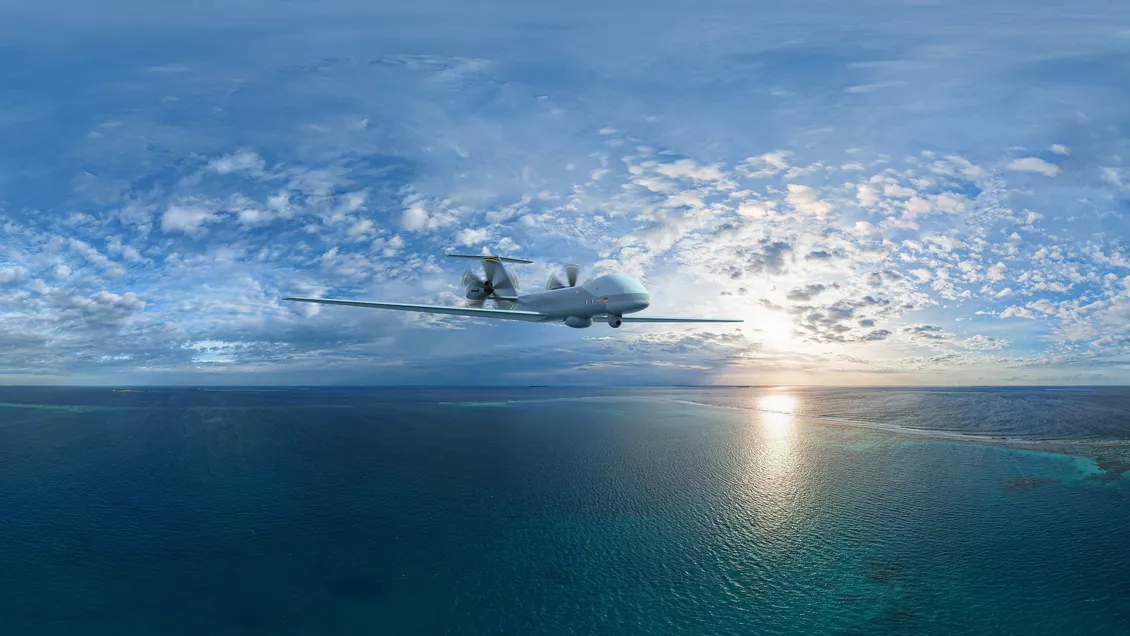
Airbus has signed an agreement with Kawasaki Heavy Industries to explore the development of a Japanese anti-submarine warfare variant of the U950 Eurodrone.
Japan has held observer status in the multinational Eurodrone program since 2023, reflecting its interest in the platform. The unmanned aircraft is scheduled to make its first flight in 2029.
As part of the agreement, Airbus and Kawasaki will study the design and development of a Japanese maritime variant of the Eurodrone, including the integration of Japanese sensors and weapons and industrial participation in production and sustainment.
The effort aims to ensure Tokyo can operate the platform independently if it decides to acquire it.
Eurodrone’s long range and extended endurance make it well-suited for maritime surveillance, while its greater payload capacity allows it to carry anti-submarine warfare systems such as sonobuoys and torpedoes.
According to Airbus, the platform could complement Japan’s existing crewed anti-submarine warfare fleet with an efficient uncrewed capability, strengthening the country’s maritime security in a sovereign and sustainable manner.
The collaboration could also strengthen European-Japanese defense cooperation and benefit future European naval variants of the Eurodrone, Airbus said.
Eurodrone
Launched in 2016, the Eurodrone program brings together France, Germany, Italy, and Spain to develop a next-generation medium-altitude, long-endurance remotely piloted aircraft system.
The project aims to reduce Europe’s reliance on non-European platforms such as the US-made MQ-9B and is being developed by Airbus, Dassault Aviation, and Leonardo. Japan and India hold observer status in the program.
Designed for missions including intelligence, surveillance, target acquisition, and reconnaissance, early warning, signals intelligence, maritime patrol, and anti-submarine warfare, the Eurodrone can carry mission payloads of up to 2.3 tonnes and remain airborne for up to 40 hours.
The aircraft is also designed to operate in civilian airspace and over open waters.