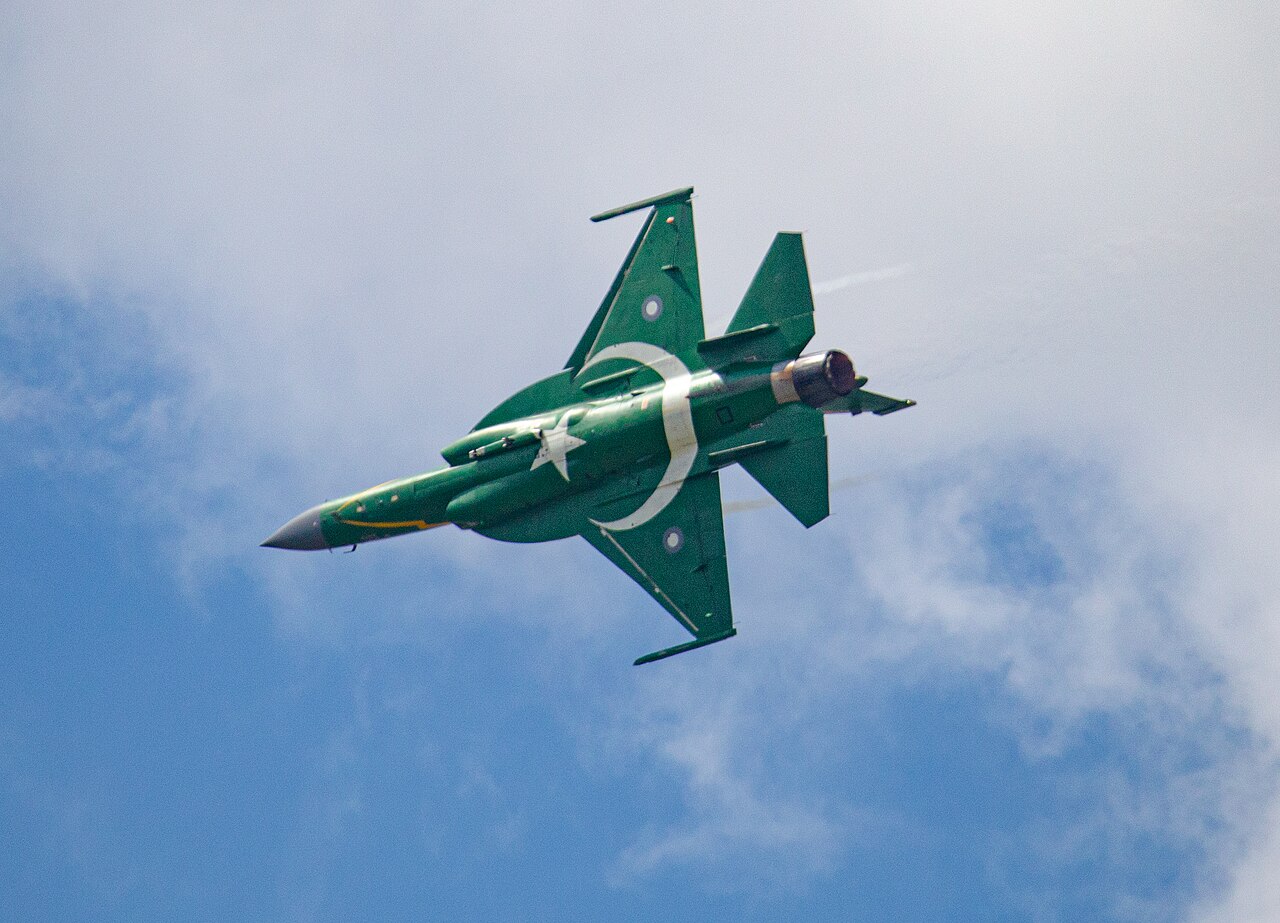
The JF-17 Thunder emerged from a simple but ambitious goal: create a modern multirole fighter that could deliver credible combat capability without the high costs of top-tier Western aircraft.
That approach helped turn the JF-17 into the centerpiece of Pakistan’s airpower strategy and a growing export platform for countries seeking capable multirole aircraft outside the traditional Western market.
This guide examines the fighter’s development, variants, operational use, and future trajectory.
At a Glance
| Category: | Details: |
| Type | Lightweight multirole fighter |
| Role | Air superiority, interception, ground attack, reconnaissance |
| Developers | Chengdu Aircraft Industry Group and Pakistan Aeronautical Complex |
| Operators | Pakistan Air Force; Myanmar, Nigeria, Azerbaijan (export operators) |
| Crew | 1 |
| Length | 14.9 meters (48.9 feet) |
| Wingspan | 9.5 meters (31.2 feet) |
| Engine | Klimov RD-93 turbofan |
| Maximum Speed | Mach 1.6 (1,975 kilometers/1,228 miles per hour) |
| Combat Radius | Approximately 1,200 to 1,350 kilometers (746 to 838 miles) |
| Ferry Range | Approximately 3,000 kilometers (1,864 miles) with external tanks |
| Service Ceiling | Approximately 55,000 feet (16,764 meters) |
| Armament | Air-to-air missiles, guided bombs, anti-ship missiles, 23mm internal cannon |
| Radar | AESA radar on Block III variants |
| Notable Features | Low operating cost, multirole flexibility, modular avionics, export-focused design |
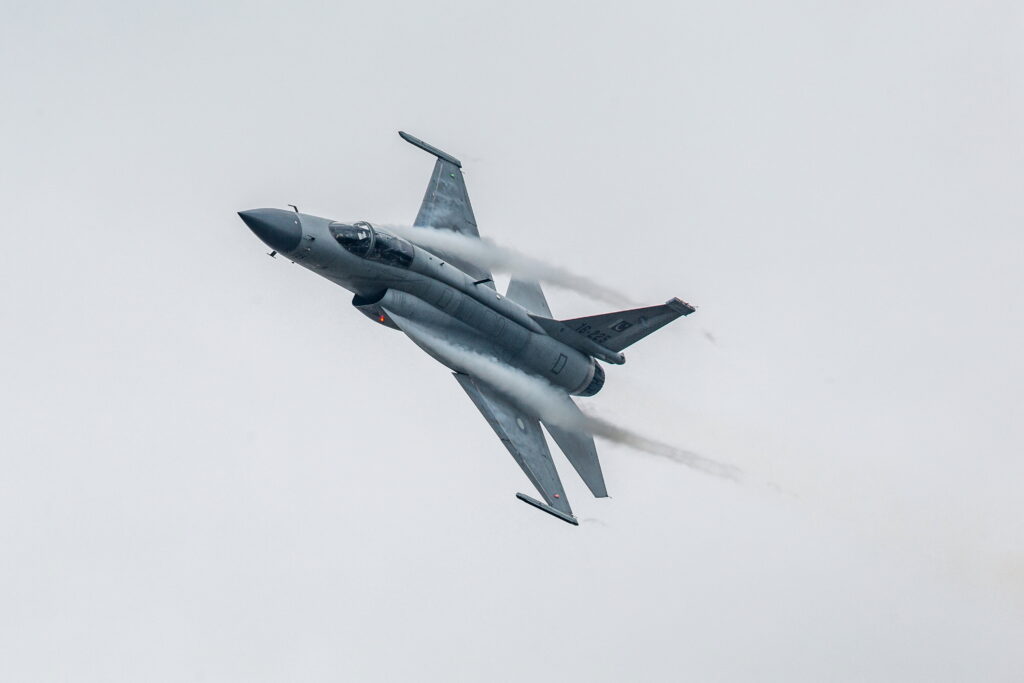
What Is the JF-17 Thunder?
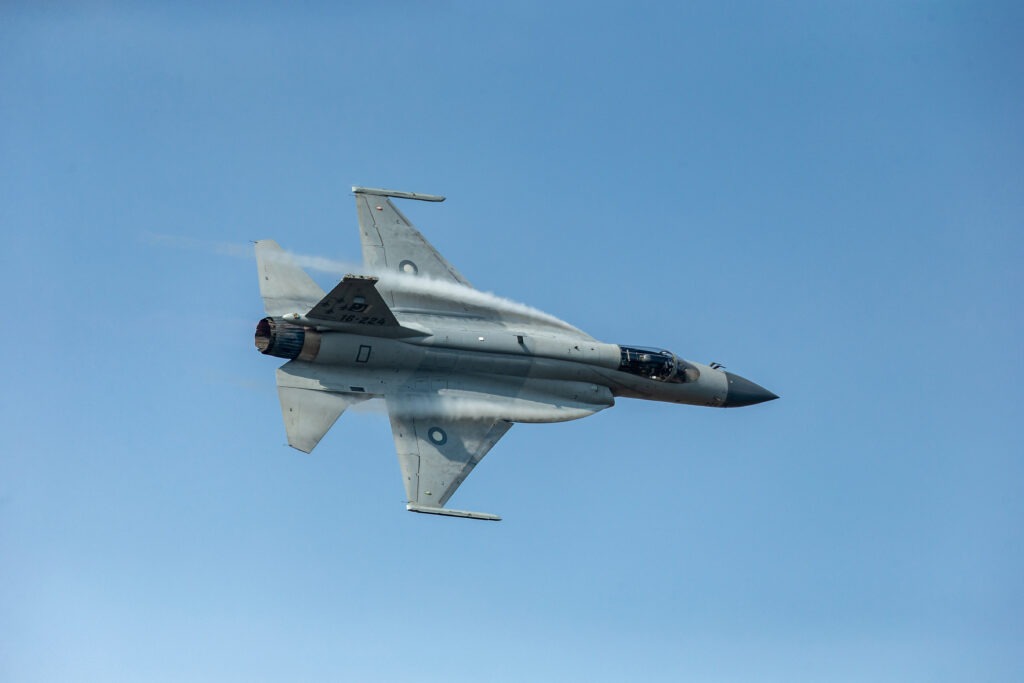
The JF-17 Thunder represents a different approach to modern fighter design. Instead of pursuing maximum complexity or cutting-edge stealth, the aircraft was built to balance combat capability, operational flexibility, and affordability in a single platform.
The single-engine multirole fighter — known in China as the FC-1 Xiaolong — was designed to conduct air defense, strike, interception, and reconnaissance missions while being easier to maintain and sustain than many Western counterparts.
How the JF-17 Came to Be
Origins of the Program
The roots of the JF-17 trace back to the 1990s, when Pakistan sought a modern fighter aircraft that could be produced domestically and maintained independently. Sanctions and procurement restrictions pushed Islamabad toward deeper defense cooperation with Beijing.
China initially explored a lightweight fighter concept through the Super-7 project, which later evolved into the FC-1/JF-17 program.
The program was led by the Chengdu Aircraft Industry Group alongside the Pakistan Aeronautical Complex, with Pakistan seeking to replace aging fleets such as the Mirage III, Mirage 5, and F-7.
Over time, the aircraft’s modular systems and expanding weapons compatibility helped transform the JF-17 from a domestic replacement program into a growing export fighter for budget-conscious air forces.
Joint Development Effort
The project became one of the most significant defense collaborations between Pakistan and China. China contributed major design and engineering expertise, while Pakistan focused on operational requirements and later production.
Serial manufacturing shifted heavily toward Pakistan through the Pakistan Aeronautical Complex in Kamra, allowing the country to assemble and upgrade the aircraft locally.
Block Upgrades for the JF-17
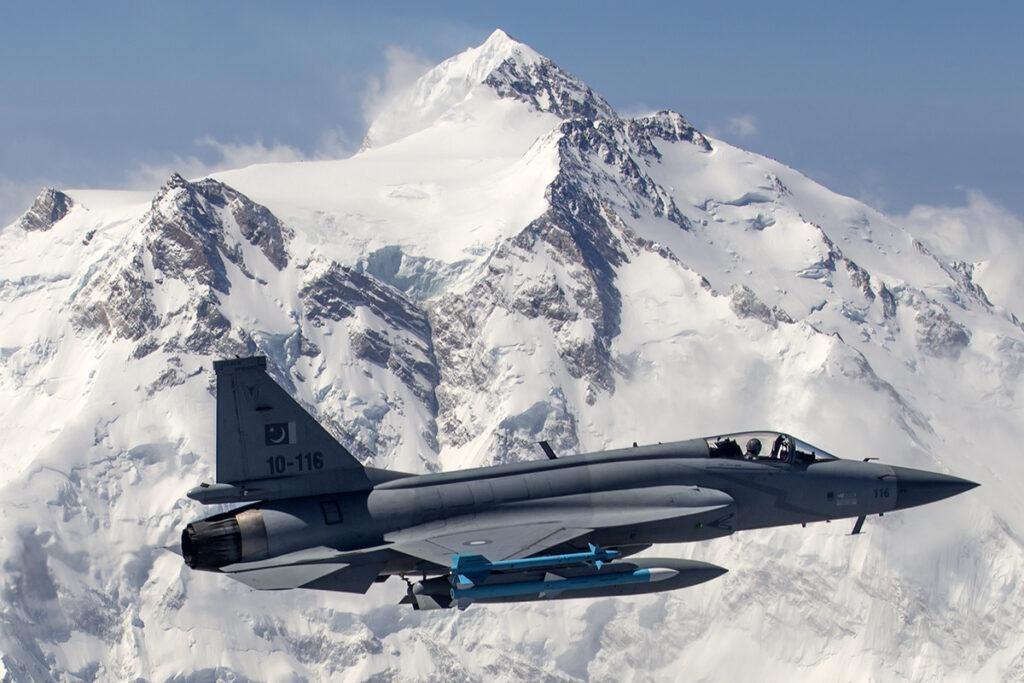
JF-17 Block I
The Block I was the first operational production standard, entering service in 2007 as a replacement for older Mirage and F-7 fighters.
While relatively simple compared to later variants, Block I established the core architecture of the program and gave Pakistan a domestically assembled fighter with modern combat functionality.
JF-17 Block II
The Block II variant marked a significant operational upgrade focused on survivability, endurance, and networked warfare.
Its most notable addition was aerial refueling capability, extending mission reach and transforming the JF-17 from a basic replacement fighter into a more mature multirole platform capable of operating in complex battlefield environments.
JF-17 Block III
This represents the most advanced evolution of the aircraft and is widely viewed as the program’s attempt to push the JF-17 toward 4.5-generation fighter standards. .
Block III incorporates an active electronically scanned array radar, improving target tracking, situational awareness, and resistance to electronic interference.
It was also designed to integrate longer-range air-to-air missiles and more advanced precision-guided weapons, significantly improving beyond-visual-range engagement capability.
How the JF-17 Works
Key Features
Lightweight Multirole Design
The aircraft’s relatively small size reduces radar visibility compared to heavier fighters while also improving agility during close-range maneuvering.
The single-engine configuration simplifies maintenance and lowers operating costs — an important factor for air forces that need to sustain frequent flight operations without the large logistics footprint associated with twin-engine combat jets.
Advanced Avionics
Later variants expanded battlefield awareness through upgraded avionics and digital combat systems.
Modern cockpit displays replace many traditional analog instruments with multifunction screens that allow pilots to track targets, navigation data, weapons status, and threats in real time.
Combined with helmet-mounted display systems and data-link connectivity, these upgrades enable pilots to engage threats more quickly and coordinate more effectively with other aircraft and ground-based systems.
Broad Weapons Compatibility
Depending on the configuration, the aircraft can be equipped with beyond-visual-range air-to-air missiles, laser-guided bombs, anti-ship missiles, precision strike munitions, and conventional unguided weapons.
This flexibility allows operators to adapt the aircraft for air superiority missions one day and maritime strike or close air support operations the next.
Compatibility with both Chinese and selected non-Chinese systems also gives export customers greater procurement flexibility than some tightly restricted Western platforms.
Strengths
- Cost-efficiency: Lower acquisition and operating costs compared to Western fighters such as the F-16 or Rafale make the JF-17 accessible to a wider range of air forces.
- Export flexibility: The aircraft appeals to countries seeking fewer political restrictions on weapons procurement and maintenance support.
- Upgrade potential: Its modular architecture allows users to integrate new radars, sensors, and weapons over time without wholesale platform replacement.
Limitations
- Engine dependency: Most JF-17 variants rely on the Russian RD-93 engine, creating potential supply vulnerabilities.
- Limited stealth: Unlike newer fifth-generation fighters, the JF-17 lacks low-observable shaping and internal weapons bays.
- Performance trade-offs: While versatile, the aircraft does not match the range, payload, or survivability of heavier advanced fighters.
Global Use and Combat Experience
The Pakistan Air Force remains the largest operator and has used the JF-17 extensively in air policing, counterterrorism missions, and regional deterrence operations.
The fighter has participated in multiple international air exercises showcasing its beyond-visual-range and precision strike capabilities.
Nigeria was the first African customer.
Myanmar also operates the platform, though its acquisition sits in a complicated context: following Myanmar’s 2021 military coup, several Western governments imposed sanctions and arms restrictions on the country’s military, making the political dimension of this export relationship relevant for defense analysts tracking the JF-17’s customer base.
Azerbaijan became the most strategically notable recent addition to the operator list, acquiring the JF-17 in late 2025. As a combat-tested, NATO-adjacent state with active regional security concerns, Azerbaijan’s adoption of a Chinese-Pakistani platform is a meaningful data point in how the global fighter market is shifting.
Future Outlook
The JF-17 program is expected to continue evolving through radar upgrades, improved electronic warfare systems, and expanded weapons integration.
Pakistan and China are also exploring enhanced networking capabilities and unmanned teaming concepts while maintaining collaborative agreements.
Although the aircraft is unlikely to rival high-end stealth fighters directly, it fills an important niche: a modern, combat-capable jet that balances performance with affordability.
For countries seeking practical airpower without the costs tied to elite Western programs, the JF-17 Thunder remains one of the most closely watched fighter platforms on the market.