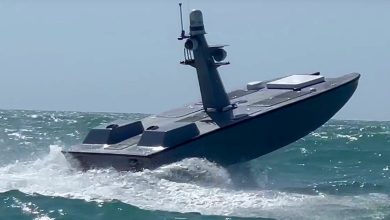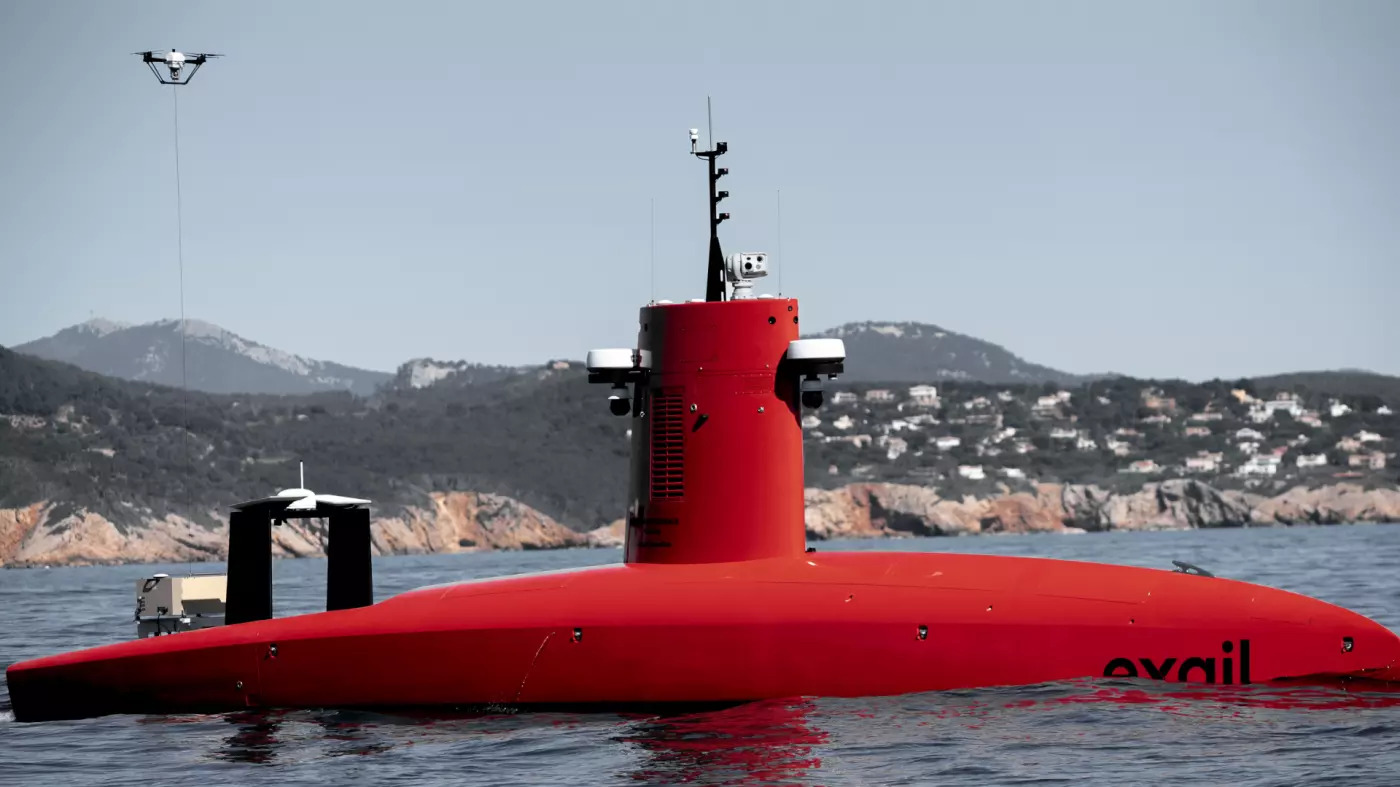

Exail has completed sea trials validating third-party sensor integration on its DriX O-16 unmanned surface vessel (USV), a step aimed at expanding the platform’s mission flexibility.
Operators controlled both the vessel and its payloads remotely from the company’s Operations Center in La Ciotat, France, demonstrating an over-the-horizon surveillance mission run entirely from shore.
The trials paired the DriX O-16 with an Elistair Khronos tethered drone and Safran’s VIGY 4 electro-optical/infrared (EO/IR) system.
The Khronos, powered and data-linked through its tether, extended the vessel’s aerial observation range beyond the horizon with long-range detection, recognition, and identification capability, while the VIGY 4 added stabilized day and night imaging across visible, mid-wave infrared, and short-wave infrared bands.
Exail said the combined sensor suite let operators detect, track, and identify maritime contacts across a range of conditions, and that the O-16 retained full autonomous navigation and mission management throughout.
Open Architecture
The O-16 is built on an open systems architecture, with Exail providing onboard power, software interfaces, and deck space so external suppliers’ payloads can be swapped in without modifying the vessel’s core autonomy software.
The company said this approach allows users to adapt the vessel for a variety of operational requirements while preserving the USV’s autonomous navigation functions.
Exail’s DriX family of USVs has been deployed for hydrographic surveying, offshore energy support, and defense applications, with the larger O-16 variant offering extended endurance and payload capacity for long-range autonomous operations.