A year ago, in June 2025, the European Commission took what many in the defense industry celebrated as a landmark step: the Defence Readiness Omnibus introduced Buy European clauses restricting certain procurement to entities established in the EU and not subject to third-country control.
A few months later, the Defence Readiness Roadmap named four European Flagships, among them the European Drone Defense Initiative and the Eastern Flank Watch. Sovereignty, it seemed, was finally being written into law.
A necessary step, in other words, but not a sufficient one.
Three Layers, Not One
The push to reduce European defense dependency on components and systems sourced outside the continent is real and overdue.
Chinese-origin supply chains are the most visible concern, and the espionage and continuity risks they carry are well documented. But external dependencies take more than one form, and not all of them originate in Beijing.
The policy conversation has so far defined sovereignty almost entirely by a single question: where do the components come from?
That is layer one of a three-layer problem. The other two layers are receiving almost no serious attention, and it is precisely in those layers that European defense systems are most exposed.

Component Sovereignty
Layer one: Where do your components come from?
The question has, for good reason, dominated the policy conversation. When Chinese-origin components can be remotely disabled, seeded with exploits, or rendered unavailable through export controls or political decisions made thousands of miles away, any system built around them is not sovereign, regardless of what flag flies on the factory.
The engineering reality of this transition, however, is considerably more demanding than the policy announcements tend to acknowledge.
Removing foreign-origin components means rebuilding supplier relationships from scratch, absorbing significant cost penalties for European-sourced alternatives, and in some cases developing subsystems entirely in-house because no European supply exists at the required specification.
Avionics. GNC algorithms. Guidance computers. Each represents a development program in its own right, and each is a decision point where the commercially expedient path and the sovereign path diverge sharply.
Component sovereignty, properly understood, amounts to a cumulative set of engineering constraints, each extracting cost and time in exchange for genuine independence, not a procurement checklist or a bill-of-materials audit.
And yet a system built entirely from European components can remain profoundly dependent on infrastructure it does not control. Which brings us to layer two.
Production Sovereignty
Layer two: Who can manufacture it, and where?
The production scaling debate in European defense gravitates toward a single prescription: build one large factory, scale it up, defend it.
It is an understandable instinct, but a centralized production model carries a centralized failure point. A single facility, however capable, can be struck, disrupted, or simply overwhelmed by a tempo of demand it was never designed to sustain.
The more searching sovereignty question is whether European technology can be manufactured by multiple actors, across multiple locations, under conditions of active disruption.
That demands a different industrial philosophy from the outset: not merely robust manufacturing, but transferable manufacturing.
Production processes straightforward enough to be replicated without specialist tooling. Designs disciplined enough that a new production line, stood up in a different country at short notice, can achieve the same output. Intellectual property held centrally; manufacturing capacity distributed across the continent.
Ukraine as Testing Ground
Ukraine is the most demanding testing ground for this thesis. The systems that performed most reliably there are those whose production was deliberately stripped back.
The fiber-optic cable experiment illustrates why: trialed as a means of maintaining control links under jamming conditions, optical fiber costs upwards of $500 per unit, frequently more than the drone itself, and the added weight degrades payload capacity.
Sophistication that cannot be manufactured and fielded at scale under operational constraints passes for capability while functioning as a liability.
Neither the European Drone Defence Initiative nor the Eastern Flank Watch flagship, as currently defined, specifies the manufacturing architecture required to make those capabilities genuinely resilient to disruption.
Capability targets and spending commitments, without distributed production requirements, address only part of the problem.
Operational Sovereignty
Layer three: Does it still work when your adversary attacks your dependencies?
GPS is not sovereign infrastructure. Neither are radio communications. Any system whose operational effectiveness depends on external signals that an adversary can jam, spoof, or deny is not truly independent, regardless of component origin or manufacturing location.
The operational record is unambiguous. Field analyses from 2024 and 2025 found that in certain operational sequences, losses attributable to jamming, severed links, or GNSS signal degradation exceeded 30 percent of drones deployed, and that figure held regardless of the technical sophistication of the platform.
Around 900 civil flights per day are affected by GPS interference across conflict-adjacent airspace.
Russian electronic warfare systems, once held in strategic reserve, are now embedded at the tactical level as a matter of routine. The electromagnetic spectrum has become the permanent operating environment of modern warfare, contested not in exceptional circumstances but continuously and by default.
This has direct engineering consequences that procurement specifications have been slow to absorb. Anti-jam navigation must be a primary design mode, not a degraded fallback.
Terminal guidance must be architecturally capable of continuing after the communications link is severed. The ability to operate without GPS must be a baseline requirement, not an optional enhancement purchased at additional cost.
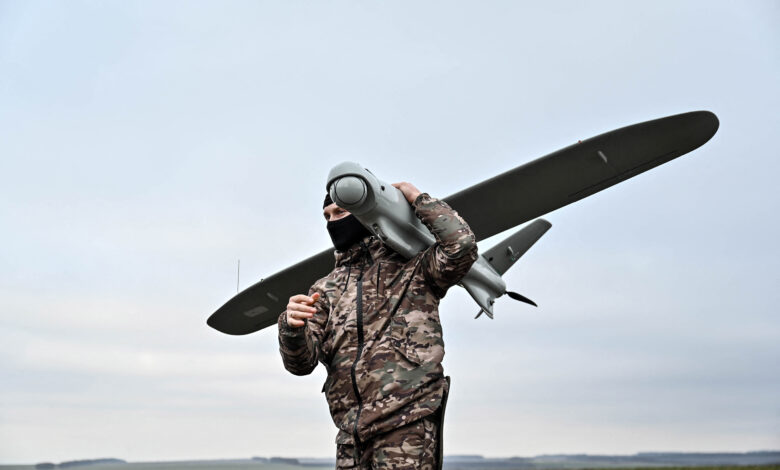
Reconnaissance platforms now in service with Ukrainian forces show the same pattern: minimal training requirements, no specialist operator skillset, and a fraction of the cost of comparable systems, because they were built on the assumption that nothing external could be relied upon.
What 800 Billion Euros in Procurement Will Lock In
The ReArm Europe plan has unlocked an estimated 800 billion euros ($917 billion) of additional European defense spending.
Procurement at this scale does not merely fill capability gaps: it institutionalizes design assumptions for a generation.
The systems acquired between now and 2030 will remain in service through the 2040s, embedding today’s architectural choices long after the political moment that produced them has passed.
The Commission’s own roadmap calls for securing supply chain resilience by reducing critical dependencies. That language should be read expansively, encompassing not only the origin of components but the operational dependencies that a capable adversary can sever at will through electronic warfare.
The policy intent is present. What remains is for procurement specifications and acceptance testing to give it teeth.
Genuine sovereignty must be designed in from the outset, a foundational engineering constraint, not an afterthought appended when the product nears completion.
The European defense industry is beginning to take layer one seriously. Layers two and three demand the same rigor, and the window to apply it is closing.

Igor Skawiński is the CEO and co-founder of FlyFocus, a Polish defense technology company specializing in unmanned aerial systems, avionics, and customized UAV subsystems for military and dual-use applications.
Trained as an aerospace engineer at the Warsaw University of Technology, he founded FlyFocus in 2018 and has led the company’s technical and strategic development since its inception.
Under his leadership, the company has delivered systems under direct contracts with the Polish Armed Forces, supported deployments to Ukraine, and expanded its customer base internationally.
The views and opinions expressed here are those of the author and do not necessarily reflect the editorial position of The Defense Post.
The Defense Post aims to publish a wide range of high-quality opinion and analysis from a diverse array of people – do you want to send us yours? Click here to submit an op-ed.